

When people search for public finance news, they are often looking for more than another headline about a government budget or a change in taxation. Public finance affects how governments collect money, where they spend it, how they manage debt, and how they prepare for economic and social challenges. These decisions can influence infrastructure, education, healthcare, employment, business activity, public services and long-term economic development.
Public finance is therefore much broader than a yearly budget announcement. The OECD describes public finance as covering government revenues, expenditures, assets and debt, with effects ranging from short-term economic conditions to income distribution, long-term growth and environmental sustainability.
A useful approach to public finance news is to look beyond individual announcements and understand the systems, trade-offs and outcomes behind them.
What Does Public Finance Actually Cover?
Public finance is essentially the management of financial resources by the public sector. It includes the money governments receive and the resources they use to provide services, invest in infrastructure, support households and businesses, and meet financial obligations.
Government revenue can come from taxation, social contributions, fees, income from public assets and other sources. Public expenditure can include employee compensation, social benefits, subsidies, infrastructure investment, public services and interest payments. The difference between revenue and expenditure contributes to the government’s fiscal balance.
This means a single public finance story can have several connected parts:
- Revenue collection
- Government spending
- Budget planning
- Fiscal deficits and surpluses
- Public debt
- Debt servicing
- Public investment
- Social protection
- Tax policy
- Public financial management
- Economic growth
- Fiscal risk
Understanding these connections makes public finance news much easier to follow.
Why Public Finance News Matters Beyond Government Offices
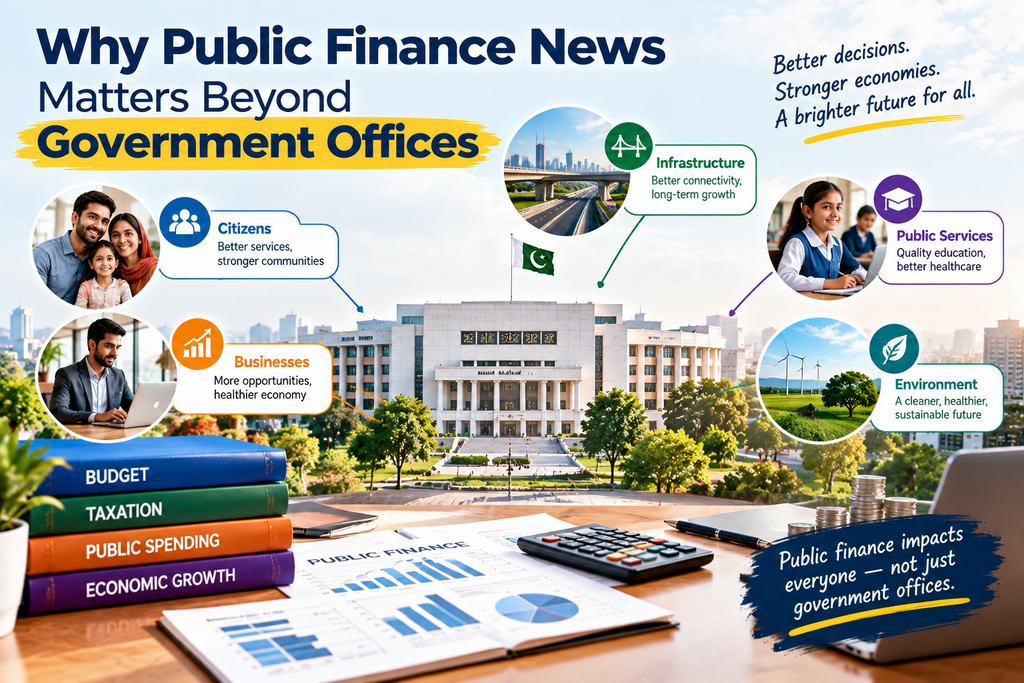
Public finance may sound like a specialist subject reserved for economists and finance ministries, but government financial decisions can eventually reach almost every household and business.
A change in taxation can affect business costs. A change in public investment can influence infrastructure development. Higher debt-service costs can affect how much money remains available for other priorities. Changes in social spending can affect household income and access to public services.
For businesses, public finance news can also provide information about the broader economic environment. Government decisions involving infrastructure, taxation, investment incentives, customs, digital services or public procurement may influence business planning.
For citizens, following public finance developments can make government decisions easier to understand because the numbers can be connected to real-world outcomes.
The Budget Is Only One Part of the Story
Government budgets receive enormous attention because they provide a structured plan for expected revenue and expenditure. However, an approved budget does not automatically mean every allocation will be spent exactly as planned.
Actual implementation matters.
A government may announce a large development allocation, but the eventual outcome depends on project preparation, procurement, cash releases, administrative capacity and implementation. This is one reason public financial management is important.
The World Bank notes that public finance reviews examine expenditure efficiency and effectiveness while also helping strengthen budget institutions and domestic revenue mobilisation.
Therefore, good public finance news should not stop at asking, “How much money was allocated?”
It should also ask:
- How much was actually released?
- How much was spent?
- What was achieved?
- Which projects were completed?
- Were the expected services delivered?
- Did spending produce measurable results?
These questions create a more complete picture of government finances.
Revenue: Where Government Money Comes From
Revenue is one of the foundations of public finance.
Governments require reliable revenue to finance public services and development. Taxes are usually a major component, but governments can also receive money from other sources.
Public finance reporting therefore often examines tax collection, tax administration, compliance, exemptions and the structure of the tax base.
A government may increase revenue by improving compliance rather than simply increasing tax rates. Digital invoicing, electronic filing, data matching and improved administration can change how effectively a tax system operates.
This is an increasingly important theme in modern public finance because technology can potentially make revenue systems more transparent and data-driven.
Spending Quality Can Matter as Much as Spending Quantity
A common mistake when reading public finance news is to focus only on whether government spending has increased or decreased.
The more important question can be: What is the money achieving?
Two governments could spend similar amounts while producing very different results because of differences in project selection, procurement, administration, monitoring and institutional capacity.
Public expenditure can support:
- Schools and universities
- Hospitals and healthcare
- Roads and transportation
- Water and sanitation
- Energy infrastructure
- Digital public services
- Social protection
- Climate adaptation
- Research and innovation
- Public safety
The effectiveness of spending depends on how resources are allocated and implemented.
The World Bank’s public financial management work highlights areas such as budget preparation, expenditure management, public investment management, accounting and accountability as important components of stronger public finance systems.
Public Debt Deserves More Than a Headline
Public debt is one of the most frequently discussed subjects in financial reporting.
Borrowing can allow governments to finance infrastructure, respond to emergencies or manage temporary gaps between revenue and expenditure. However, debt also creates future obligations, particularly when governments must pay interest and repay borrowed funds.
That is why public finance news often tracks:
- Total public debt
- Debt-to-GDP ratios
- Domestic borrowing
- External borrowing
- Interest payments
- Debt maturities
- Refinancing requirements
- Currency exposure
- Debt sustainability
The OECD has highlighted that many countries are dealing with high or rising public debt alongside spending pressures related to ageing populations, defence, climate issues and social support.
A useful reader should therefore avoid judging a country’s finances from a single debt number. Debt levels need to be considered alongside economic growth, revenue capacity, interest costs, maturity structures and the government’s ability to manage future obligations.
Deficits Do Not Tell the Whole Story
A fiscal deficit occurs when government expenditure exceeds revenue during a particular period. A surplus occurs when revenue exceeds expenditure.
The OECD describes the fiscal balance as the difference between government revenue and expenditure. Persistent deficits can contribute to debt accumulation over time.
But the existence of a deficit alone does not explain why it exists.
A deficit might be influenced by:
- Weak economic activity
- Emergency spending
- Infrastructure investment
- Lower-than-expected tax revenue
- Higher interest payments
- Subsidies
- Social protection requirements
- Natural disasters
- Energy-price shocks
This is why quality public finance news should provide context rather than presenting one fiscal number without explanation.
Public Finance and Infrastructure
Infrastructure is another area where public finance becomes visible in everyday life.
Roads, public transport, electricity systems, water networks, schools and hospitals all require financial planning. Large infrastructure projects can also affect productivity and private investment.
However, infrastructure spending involves more than announcing a project. Governments need to consider construction costs, financing arrangements, maintenance requirements, expected economic benefits and implementation timelines.
A project that is completed without adequate maintenance planning may create future financial pressure.
For this reason, public investment should be considered across its entire life cycle rather than only during the construction stage.
Digital Transformation Is Changing Public Finance
Technology is becoming increasingly relevant to government finance.
Digital tax systems can improve collection and reporting. Electronic procurement can make purchasing processes easier to monitor. Digital payment systems can reduce administrative friction. Data analytics can help governments identify unusual transactions or improve forecasting.
Digital public finance can also make information easier for citizens to access.
When budgets, expenditure reports, procurement information and financial statistics are published in accessible formats, researchers, journalists, businesses and citizens can examine government activity more effectively.
This creates an important connection between public finance and transparency.
Climate Risk Is Becoming a Fiscal Issue
Climate-related events can create substantial financial pressures for governments.
Floods, droughts, storms, extreme temperatures and other environmental risks can damage infrastructure, reduce agricultural output and increase emergency spending.
As a result, climate resilience is increasingly connected with fiscal planning.
Public finance systems may need to account for the potential cost of disasters, climate adaptation projects, resilient infrastructure and changes in insurance or financing requirements.
Recent international public-finance discussions increasingly connect fiscal planning with climate resilience and long-term risk management.
This is an important development because governments are not only managing today’s budget; they are also planning for financial risks that may emerge years later.
Why Public Finance News Is Becoming More Data-Driven
Modern readers have access to more government financial information than ever before.
Official budget documents, fiscal statements, debt reports, expenditure databases and economic statistics can provide detailed evidence behind major headlines.
For example, Pakistan’s Ministry of Finance currently publishes budget updates alongside documents such as fiscal policy statements, debt policy statements, budget strategies and performance monitoring reports.
This allows readers to move beyond headlines and examine the underlying documents.
The same principle applies internationally. OECD government finance statistics cover revenue, expenditure, borrowing or lending and government financial accounts across national, state and local levels.
What Businesses Should Watch in Public Finance News
Businesses can use public finance coverage to monitor the broader operating environment.
Important areas include:
Tax Policy
Changes in corporate taxes, sales taxes, customs duties or tax incentives can influence business planning.
Government Investment
Infrastructure and development spending can create opportunities for companies involved in construction, technology, logistics, energy and professional services.
Public Procurement
Government purchasing can represent a significant market for eligible businesses.
Debt and Interest Costs
Changes in government borrowing conditions can influence the wider financial environment.
Regulatory Reform
Changes to public-sector systems may create new compliance requirements as well as opportunities for innovation.
Following these areas can make public finance news useful for strategic business planning rather than simply general economic reading.
How to Read Public Finance News More Critically
A strong reader should look at several layers of information.
First, identify the announcement.
Second, examine the numbers behind it.
Third, compare the new figures with previous targets or actual results.
Fourth, determine whether the information refers to the central government, local government, or the broader public sector.
Fifth, check whether the figures are estimates, forecasts, revised numbers or final results.
Finally, consider the implementation side.
This approach helps prevent a common problem in financial reporting: treating a planned allocation as if it were already an achieved outcome.
The Future of Public Finance Reporting
The future of public finance reporting is likely to become more connected to data, technology, transparency and long-term risk.
Readers increasingly want more than statements about whether a government increased or reduced spending. They want to know what changed, why it changed, where the money went and what resulted from it.
That shift can make public finance journalism more valuable.
Interactive datasets, budget trackers, open-government portals and digital reporting can help transform complicated financial documents into information that ordinary readers can understand.
At the same time, financial reporting must distinguish between official forecasts, actual results and independent analysis.
Final Thoughts
Public finance news provides a window into how governments manage collective financial resources. It covers much more than annual budgets. Revenue collection, expenditure quality, public debt, fiscal deficits, infrastructure, digital transformation, climate risks and transparency are all connected parts of the public finance system.
The most useful way to follow this subject is to look beyond individual numbers and understand the relationship between money, policy, implementation and outcomes.
A budget tells us what a government plans to do. Revenue data tells us what it can collect. Expenditure data shows where resources are going. Debt figures reveal future obligations. Performance information helps answer the most important question: what did the spending actually achieve?
That broader perspective makes public finance news easier to understand and far more useful for citizens, businesses, researchers and anyone interested in how public resources shape economic development.
1 thought on “Public Finance News: Understanding the Decisions Behind Government Money”