
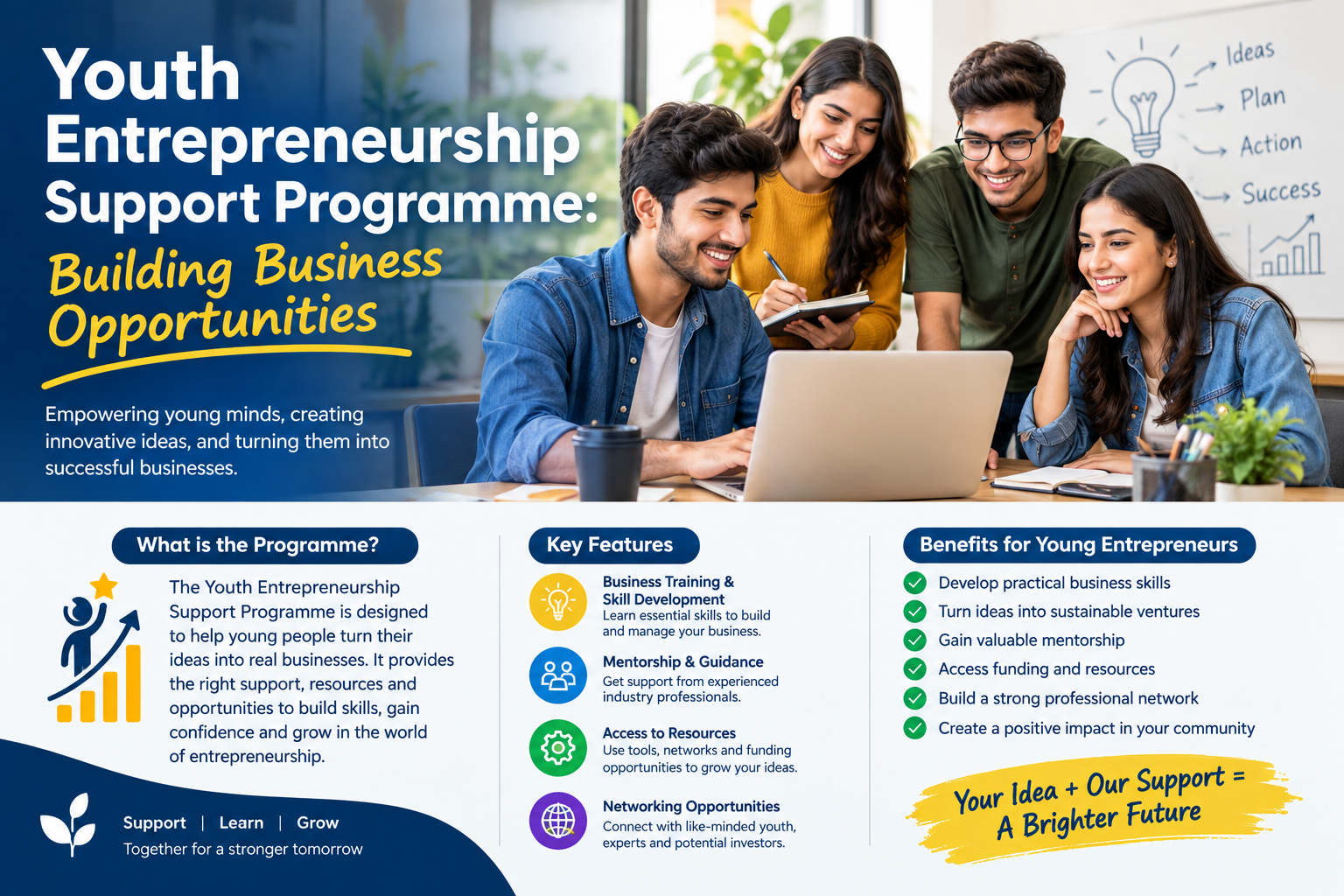
Young people today have more opportunities to turn ideas into businesses than ever before. Digital platforms, remote work, e-commerce, social media, technology and online education have lowered many traditional barriers to starting a business. However, having an idea is only the beginning. Young entrepreneurs also need practical skills, financial knowledge, mentorship, market access, confidence and the ability to make informed decisions.
This is where a youth entrepreneurship support programme can make a meaningful difference. A well-designed programme does more than provide startup funding. It can help young people understand their markets, test ideas, develop business models, manage finances, build professional networks and create businesses capable of surviving beyond the initial launch stage.
Across different countries, youth entrepreneurship initiatives increasingly combine training, mentoring, finance, incubation and ecosystem connections. In Pakistan, for example, the youth entrepreneurship ecosystem has expanded through incubation centres, funding opportunities and entrepreneurship-focused initiatives, although access to education, employment, connectivity and other resources remains uneven.
What Is a Youth Entrepreneurship Support Programme?
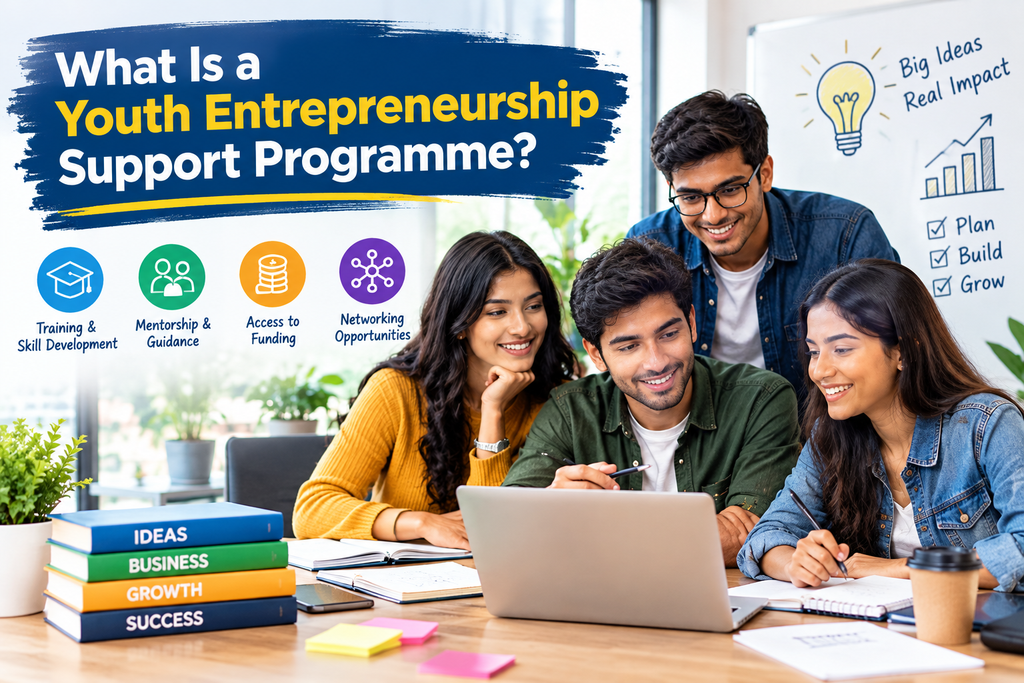
A youth entrepreneurship support programme is a structured initiative designed to help young people develop entrepreneurial capabilities and, where appropriate, establish or grow businesses.
The strongest programmes do not treat entrepreneurship as simply “getting a loan.” Instead, they recognize that a new entrepreneur may need several forms of support at different stages.
These can include:
- Business and financial education
- Entrepreneurship training
- Mentoring and coaching
- Business-plan development
- Idea validation
- Incubation and acceleration
- Access to finance
- Digital and technical skills
- Networking opportunities
- Market and customer access
- Business registration guidance
- Post-launch support
The combination is important because entrepreneurs often face different challenges at different stages of their journey.
Why Youth Entrepreneurship Support Matters
Young people can bring creativity, technology awareness and fresh approaches to business problems. Yet enthusiasm alone does not guarantee business sustainability.
A young founder may understand social media but struggle with accounting. Another may have a strong technical skill but no experience in sales. Someone else may have a promising product but limited knowledge of customer research.
A strong support programme connects these missing pieces.
The International Labour Organization has previously described entrepreneurship training for disadvantaged youth as a way of promoting entrepreneurship as a career option while addressing youth employment challenges. Its approach includes assessing entrepreneurial potential and the local business environment, followed by training and post-training services.
This shows why effective support should continue beyond a classroom or one-time workshop.
From Business Idea to Business Model
One of the most valuable parts of a youth entrepreneurship support programme is helping participants move from an exciting idea to a realistic business model.
Young entrepreneurs often begin with statements such as:
“I have a great product.”
“I can build an app.”
“People will buy this service.”
The next step is asking practical questions.
Who is the customer?
What problem does the product solve?
How much will customers pay?
Who are the competitors?
What will it cost to produce or deliver?
How will customers discover the business?
What makes the business different?
Answering these questions helps transform an idea into something that can be tested.
Recent entrepreneurship training in Pakistan, for example, has included entrepreneurial mindset development, idea validation and business-model development, showing how structured learning can help students move beyond the initial idea stage.
Practical Training Should Come Before Bigger Decisions
Entrepreneurship education becomes more valuable when participants can apply what they learn.
Instead of focusing exclusively on theory, a modern programme can include practical exercises such as creating a basic business model, interviewing potential customers, calculating costs, preparing a simple cash-flow forecast and developing a first marketing plan.
Participants can also learn how to create invoices, maintain records, negotiate with suppliers and communicate professionally with customers.
These may seem like small skills, but together they form the foundation of responsible business management.
Mentorship Can Give Young Entrepreneurs a Clearer Direction
Training provides knowledge, while mentorship can provide perspective.
An experienced mentor can help a young founder identify unrealistic assumptions, think through business challenges and recognize opportunities that may otherwise be overlooked.
Mentorship is particularly useful after a programme participant starts operating a business. At that stage, real problems begin to appear: customers may respond differently than expected, expenses may increase, sales may fluctuate or a product may need improvement.
International youth entrepreneurship networks commonly include mentoring and access to finance as important components of entrepreneur-support programmes.
The objective should not be for mentors to make decisions for young founders. Instead, mentors can help entrepreneurs ask better questions and make better-informed decisions themselves.
Access to Finance Is Important, But It Is Not the Whole Solution
Finance can help a business purchase equipment, develop products, hire workers, build inventory or reach new customers. But funding without preparation can create problems.
A youth entrepreneurship support programme can therefore combine financial access with financial literacy.
Participants should understand:
- Startup costs
- Working capital
- Revenue
- Profit margins
- Cash flow
- Debt obligations
- Interest costs
- Emergency reserves
- Investment requirements
Pakistan has used youth-focused financing initiatives as part of its broader entrepreneurship ecosystem. More recently, the Small and Medium Enterprises Development Authority and Prime Minister’s Youth Programme announced a collaboration intended to improve awareness and access to financial and business-development support for MSMEs and aspiring young entrepreneurs.
This combination of finance and business-development support is important because sustainable entrepreneurship requires more than access to capital.
Digital Skills Can Expand Entrepreneurial Possibilities
The modern entrepreneur does not necessarily need a large physical office or traditional storefront.
A young person can potentially build a business through e-commerce, digital services, content creation, software, online education, consulting, freelancing or technology-enabled local services.
For this reason, youth entrepreneurship support programmes can benefit from including digital skills such as:
- Website development
- E-commerce management
- Digital marketing
- Search engine optimization
- Social media marketing
- Online payments
- Customer relationship management
- Data analysis
- Basic cybersecurity
- Productivity and automation tools
Digital knowledge can help young entrepreneurs reduce operational costs and reach customers beyond their immediate geographic area.
Networking Can Open Doors That Training Cannot
Entrepreneurship is rarely a completely individual journey.
Young founders can benefit from meeting other entrepreneurs, suppliers, investors, industry professionals, potential customers and experienced business owners.
A good programme can therefore create networking opportunities through workshops, business meetups, founder sessions, industry visits and community events.
Networking can lead to partnerships, referrals, collaborations and new market opportunities. It can also reduce the isolation that some first-time entrepreneurs experience.
The goal should not simply be to collect contacts. It should be to develop meaningful professional relationships.
Supporting Rural and Underserved Young Entrepreneurs
A truly inclusive youth entrepreneurship support programme should consider participants who do not live in major commercial centres.
Young people in rural communities may have strong entrepreneurial potential but face different challenges involving connectivity, finance, transportation, market access and specialized training.
The International Fund for Agricultural Development’s Youth Entrepreneurship and Employment Support Services Programme, for example, focuses on rural youth and connects entrepreneurship with rural transformation, agriculture, technology and modern employment opportunities.
This broader approach demonstrates why youth entrepreneurship programmes should be adapted to local economic conditions rather than relying on a single model for every community.
Women and Other Underserved Groups Need Accessible Support
Entrepreneurship opportunities are not always equally accessible.
Young women, people with disabilities, rural communities and other underserved groups can encounter additional barriers involving finance, mobility, education, networks and market participation.
UNDP’s research on inclusive youth entrepreneurship in the Asia-Pacific region highlights the importance of strengthening support systems for young entrepreneurs from underserved communities and addressing structural barriers to participation.
A stronger programme can therefore include accessible training, flexible learning options, targeted mentoring, digital access and appropriate financial pathways.
Measuring Success Beyond the Number of Participants
One weakness of many training initiatives can be an excessive focus on how many people attended.
A more meaningful youth entrepreneurship support programme can measure longer-term outcomes.
For example:
- How many businesses were launched?
- How many remained active?
- How many created jobs?
- Did revenue increase?
- Did participants gain new customers?
- Did businesses improve their financial management?
- How many entrepreneurs accessed markets or finance?
- How many participants continued receiving mentorship?
Current programme reporting from Africa shows how entrepreneurship initiatives can track measures such as young people reached, businesses started, businesses strengthened, jobs secured, training completed, finance received and mentoring provided.
These types of measurements provide a clearer picture of whether support is producing meaningful economic outcomes.
Building Businesses That Can Survive
Starting a business is an achievement, but sustainability is the bigger challenge.
A young entrepreneur needs to understand how to manage changing customer demand, control expenses, maintain quality, compete in the market and adapt when circumstances change.
This is why post-launch support deserves as much attention as pre-launch training.
Regular mentoring sessions, peer communities, business clinics and advanced workshops can help entrepreneurs continue learning after their initial programme ends.
The most valuable support may therefore be the support that remains available when the excitement of launching a business has passed.
Creating a Stronger Entrepreneurial Culture
A successful youth entrepreneurship support programme can influence more than individual businesses.
When young people see entrepreneurship as a realistic career and economic pathway, it can contribute to a wider culture of innovation, problem-solving and self-employment.
Successful entrepreneurs can become mentors for future participants. Growing businesses can employ other young people. Local suppliers can gain new customers. Communities can develop stronger commercial networks.
This creates a cycle in which entrepreneurship support contributes to a broader ecosystem rather than helping only one individual at a time.
The Future of Youth Entrepreneurship Support
The next generation of entrepreneurship programmes is likely to become more personalized, technology-enabled and outcome-focused.
Instead of giving every participant identical training, programmes can assess individual needs and provide different pathways for different entrepreneurs.
Someone with a strong business idea but limited financial knowledge may need financial education. A technically skilled founder may need sales and marketing support. An existing small business may need market expansion, digital transformation or working-capital guidance.
Technology can also make mentorship, training and business resources more accessible to young people outside major cities.
Final Thoughts
A youth entrepreneurship support programme can be much more than a training course or funding opportunity. At its strongest, it creates a complete support environment where young people can learn, test ideas, develop practical skills, access appropriate resources, build professional relationships and continue improving after launching their businesses.
The growing entrepreneurship ecosystem in Pakistan and other regions demonstrates the importance of combining finance, skills, mentorship, incubation, digital opportunities and market access.
For young entrepreneurs, the biggest value of structured support may not be receiving one opportunity. It may be gaining the knowledge, confidence and network needed to recognize the next opportunity.
When programmes focus on sustainable businesses rather than short-term participation numbers, they can help young people turn entrepreneurial ambition into practical economic activity, stronger communities and new opportunities for future generations.
1 thought on “Youth Entrepreneurship Support Programme: Building Business Opportunities”