
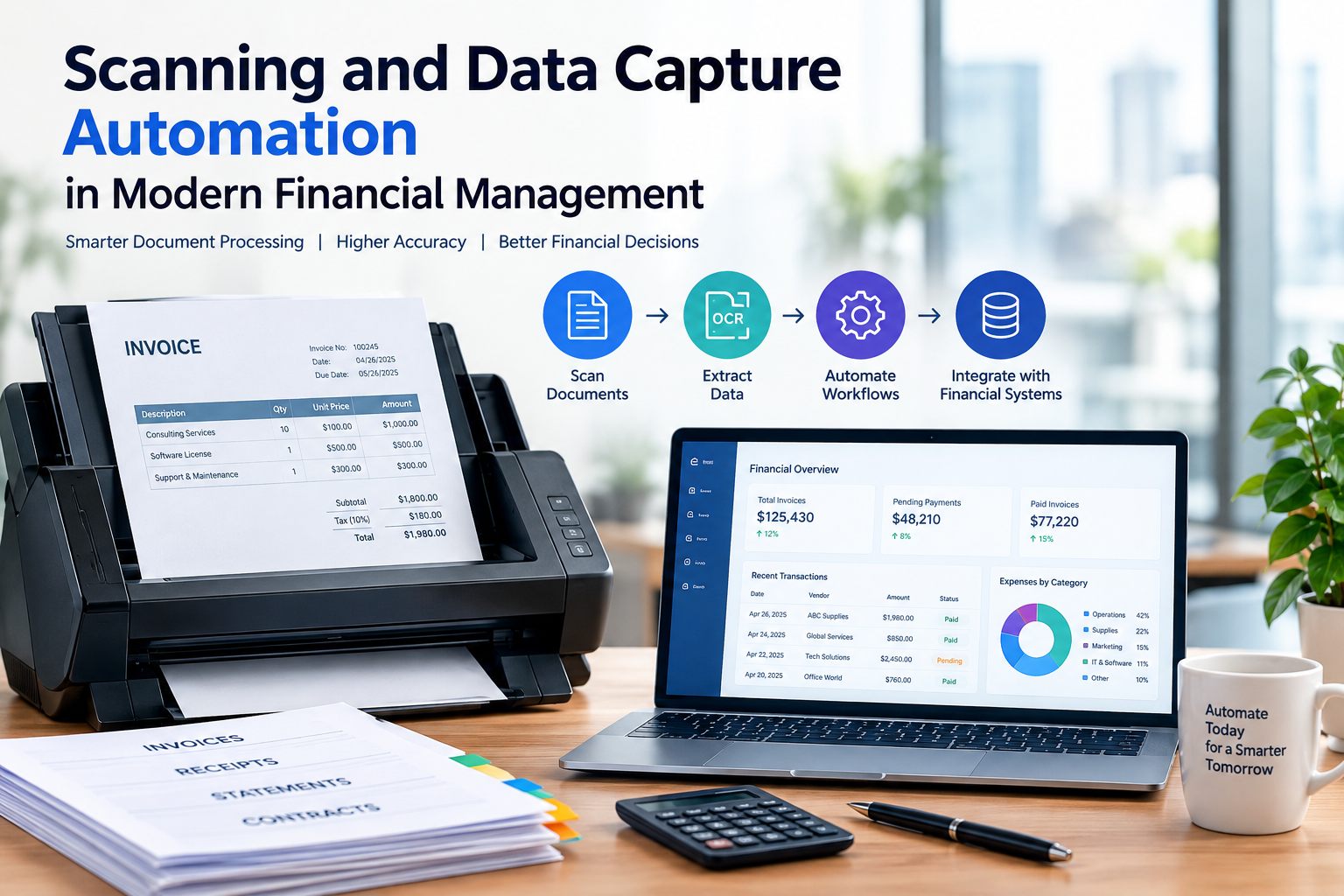
Scanning and Data Capture Automation in Modern Financial Management
Modern financial management is undergoing a remarkable transformation. As businesses expand, financial teams are expected to process increasing volumes of invoices, receipts, statements, contracts, payment records, and other documents while maintaining speed, accuracy, security, and compliance. Traditional manual data entry methods can make these responsibilities time-consuming and challenging. This is where Scanning and Data Capture Automation in Modern Financial Management has emerged as an important technological advancement.
By combining document scanning, intelligent data extraction, automation, and digital workflows, businesses can transform large amounts of financial information into structured and usable data. This approach not only reduces repetitive administrative work but also enables finance professionals to concentrate on analysis, planning, and strategic decision-making.
Transforming Traditional Financial Processes
For many years, financial departments relied heavily on paper documents and manual data entry. Employees had to read information from invoices or receipts, enter details into spreadsheets or accounting platforms, verify figures, and organize records for future reference. While these processes may work on a small scale, they become increasingly difficult as transaction volumes grow.
Scanning and data capture automation provides a more efficient alternative. Documents can be scanned or uploaded digitally, while intelligent technologies identify relevant information and convert it into structured data. Details such as invoice numbers, dates, supplier names, tax amounts, totals, and payment information can be captured and prepared for further processing.
This transformation allows finance teams to move away from repetitive data-entry tasks and toward more productive activities.
Modern Financial Management
Accuracy is one of the most important requirements in financial management. Even a small data-entry mistake can create problems in accounting records, reporting, reconciliation, or payment processing. Manual processes can increase the possibility of errors, particularly when employees are working with large volumes of documents.
Automated data capture can significantly improve consistency by extracting information according to predefined rules and intelligent recognition technologies. Instead of repeatedly typing information into financial systems, businesses can establish automated workflows that standardize the way data is collected and processed.
Better data quality also helps organizations maintain cleaner financial records. When reliable information is available across systems, finance teams can work more confidently and make decisions based on organized and accessible data.
Saving Valuable Time for Finance Teams
Time is an important resource for every organization. Financial professionals should ideally spend more time analyzing business performance, managing budgets, monitoring cash flow, and supporting strategic decisions rather than performing repetitive administrative tasks.
Scanning and data capture automation can reduce the amount of time required to process financial documents. Once information is captured, it can be transferred into relevant systems and workflows with fewer manual steps.
For example, an organization receiving hundreds of invoices every month can automate the initial stages of invoice processing. Instead of manually reviewing and entering every invoice, employees can focus their attention on exceptions, approvals, verification, and more complex financial responsibilities.
This creates a more productive environment while allowing organizations to handle growing workloads without unnecessarily increasing administrative effort.
Supporting Faster Invoice Processing
Invoice management is an area where automation can make a particularly meaningful difference. Businesses regularly receive invoices from suppliers, service providers, contractors, and partners. Managing these documents manually can involve multiple stages, including data entry, validation, approval, coding, and payment preparation.
Automated scanning and data capture can help simplify these stages by extracting essential invoice information and directing it through predefined workflows. Relevant team members can receive documents for approval, while financial systems can use captured information for accounting and payment processes.
Faster invoice processing can also contribute to stronger supplier relationships. Timely processing and accurate records help businesses maintain organized payment schedules and reduce unnecessary delays.
Strengthening Financial Visibility
Modern businesses need timely access to financial information. Decision-makers may need to understand expenses, supplier activity, cash flow, outstanding invoices, and other financial indicators without waiting for lengthy manual processes.
Automation helps create a more connected flow of financial information. When documents are digitized and captured efficiently, organizations can make relevant information available within their financial systems sooner.
Improved visibility allows management teams to monitor financial activity more effectively. Instead of relying exclusively on scattered paperwork or manually maintained spreadsheets, businesses can build more organized digital records that support reporting and analysis.
Enhancing Compliance and Record Management
Financial organizations operate in environments where documentation, record keeping, and compliance are extremely important. Businesses may need to maintain financial documents for audits, tax requirements, internal controls, and regulatory purposes.
Digital document capture can make records easier to organize, search, retrieve, and manage. Automated workflows can also help establish consistent processes for handling financial documentation.
A well-organized digital record system can make it easier for authorized employees to locate specific documents when required. This can reduce the time spent searching through physical files and help organizations maintain more structured documentation practices.
Supporting Better Security
Financial documents often contain sensitive information. Protecting this information is essential for businesses of every size. Paper-based systems can create challenges because physical documents may be misplaced, damaged, copied, or accessed by unauthorized individuals.
Digitizing financial information can support more controlled document management. Organizations can establish access permissions, digital workflows, authentication procedures, and centralized storage policies according to their requirements.
Although technology does not eliminate every security risk, a properly designed automated document environment can provide organizations with stronger tools for controlling and monitoring access to financial information.
Enabling Smarter Financial Decision-Making
The true value of automation goes beyond simply reducing manual work. When financial information becomes available in a structured and timely format, organizations can use it more effectively for analysis and planning.
Finance leaders can gain better insight into spending patterns, supplier costs, outstanding obligations, and operational performance. This information can contribute to more informed budgeting and forecasting.
Instead of spending most of their working hours collecting information, finance professionals can dedicate more attention to understanding what the information means. This shift from data entry to data intelligence represents one of the most valuable benefits of modern financial automation.
Scalability for Growing Businesses
A growing business naturally generates more financial documents and transactions. A process that works for a small organization may become inefficient as transaction volumes increase.
Automation provides greater scalability by reducing dependence on repetitive manual processing. Businesses can establish standardized workflows that continue to support operations as document volumes increase.
This can be particularly valuable for organizations expanding into new markets, adding suppliers, increasing customer activity, or managing multiple business units. A scalable digital process helps financial operations keep pace with organizational growth.
The Future of Financial Management
The future of financial management is increasingly digital, connected, and intelligent. Technologies such as optical character recognition, intelligent document processing, artificial intelligence, machine learning, cloud platforms, and workflow automation are continuing to change how businesses manage information.
Scanning and data capture automation is an important part of this transformation. It provides a practical bridge between traditional documents and modern digital financial systems.
As technology continues to develop, automated solutions are expected to become more capable of recognizing complex documents, identifying relevant information, detecting inconsistencies, and supporting increasingly sophisticated workflows.
Businesses that embrace these developments can create financial operations that are more efficient, organized, and adaptable.
Conclusion
Scanning and Data Capture Automation in Modern Financial Management represents a significant step toward more efficient and intelligent financial operations. By transforming paper-based and manually processed information into structured digital data, businesses can improve accuracy, save valuable time, strengthen record management, and provide finance teams with better access to important information.
Perhaps the greatest advantage is that automation allows financial professionals to focus less on repetitive administrative work and more on activities that contribute directly to business growth. From invoice processing and document management to financial reporting and strategic planning, automated data capture can support numerous areas of modern finance.
In an increasingly competitive business environment, efficiency and reliable information are essential. Organizations that adopt smarter approaches to financial document processing can build stronger foundations for productivity, visibility, and long-term growth.
As financial management continues to evolve, scanning and data capture automation will remain an important technology for businesses looking to modernize their operations and turn everyday financial information into meaningful business value.