
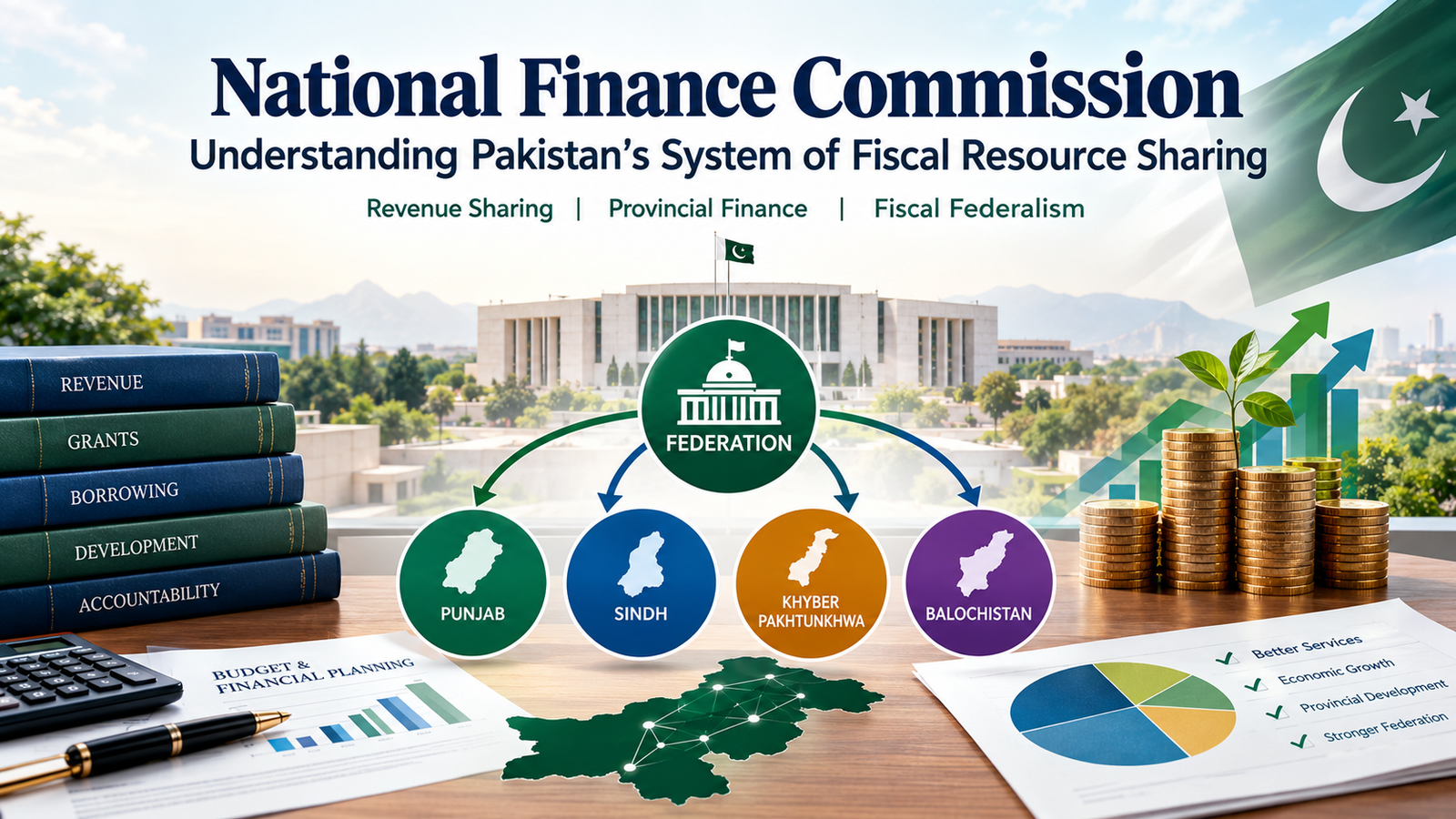
The National Finance Commission is one of the most important financial institutions in Pakistan’s federal system. It provides the constitutional framework through which financial resources are discussed and recommendations are made for sharing revenues between the Federation and the provinces. While the term is often associated with the NFC Award and provincial shares, its importance goes much further: it is connected with grants, borrowing powers, fiscal coordination, accountability and the broader relationship between federal and provincial governments.
For readers trying to understand Pakistan’s public finance system, the National Finance Commission offers an important starting point because it explains how a federation can organize financial responsibilities among different levels of government.
What Is the National Finance Commission?
The National Finance Commission is established under Article 160 of the Constitution of Pakistan. The Constitution provides that the President constitutes the Commission at intervals not exceeding five years. Its membership includes the Federal Finance Minister, the Finance Ministers of the provinces and other members who may be appointed after consultation with the provincial governors.
The Commission’s responsibilities include making recommendations regarding the distribution of the net proceeds of specified taxes between the Federation and provinces, grants-in-aid to provincial governments, borrowing powers and other financial matters referred to it by the President.
This makes the National Finance Commission more than a formula for dividing money. It is part of the constitutional architecture governing Pakistan’s intergovernmental fiscal relationship.
Why the National Finance Commission Matters
Federal governments collect a substantial portion of national tax revenue, while provincial governments are responsible for many areas of public service delivery. This creates a practical question: how should nationally collected resources be distributed so that different levels of government can meet their responsibilities?
The National Finance Commission provides the institutional forum for addressing this question.
The issue is not simply about how much money one government receives. Resource distribution can influence provincial budgeting, development planning, public services and the ability of governments to manage their responsibilities.
A well-understood NFC framework therefore helps explain why discussions about taxation, provincial autonomy, public spending and fiscal sustainability are often connected.
Understanding the NFC Award
The NFC Award is the legal instrument through which the President gives effect to the revenue-distribution recommendations of the National Finance Commission. The Ministry of Finance explains that Article 160 provides the constitutional basis for this process.
Pakistan’s 7th NFC Award remains particularly important in the country’s fiscal history. It was signed on December 30, 2009, and its recommendations received legal effect from July 1, 2010 through President’s Order No. 5 of 2010.
Rather than treating the Award as merely a percentage table, it is useful to view it as a framework for managing the financial relationship between two levels of government.
Vertical Distribution: Federation and Provinces
One of the central concepts in the NFC system is vertical distribution.
Vertical distribution concerns the division of resources between the Federal Government and the provincial governments. Under the 7th NFC Award, the provinces’ share of the divisible pool was increased to 56% for 2010–11 and 57.5% for subsequent years of the Award, according to the Khyber Pakhtunkhwa government’s official budget documentation.
This arrangement is significant because provincial governments need predictable financial resources to plan and deliver services within their constitutional responsibilities.
The Constitution also contains an important protection: the share assigned to provinces in an NFC Award cannot be lower than the share assigned to them in the previous Award.
Horizontal Distribution: Sharing Among Provinces
The second major concept is horizontal distribution, which deals with how the provincial share is divided among Punjab, Sindh, Khyber Pakhtunkhwa and Balochistan.
The 7th NFC Award introduced a multiple-criteria approach rather than relying only on population. The official fiscal policy documentation lists population at 82%, poverty and backwardness at 10.3%, revenue collection or generation at 5%, and inverse population density at 2.7%.
The resulting provincial shares were recorded as 51.74% for Punjab, 24.55% for Sindh, 14.62% for Khyber Pakhtunkhwa and 9.09% for Balochistan.
This approach is important because provinces differ considerably in population, geographic conditions, revenue generation and development needs.
Why Multiple Criteria Changed the Discussion
A single population-based formula can provide a straightforward method of distribution, but it does not necessarily capture every fiscal challenge faced by a province.
The 7th NFC Award therefore incorporated several indicators. Population remained the largest factor, while poverty and backwardness, revenue generation and inverse population density were also recognized.
This makes the National Finance Commission an interesting example of how public finance can attempt to balance size, need, fiscal contribution and geographic conditions within one framework.
The purpose of examining these indicators is not simply mathematical. Each indicator represents a different way of understanding what constitutes a reasonable allocation of public resources.
Grants and Other Financial Responsibilities
The National Finance Commission’s constitutional role extends beyond divisible-pool distribution.
Article 160 also refers to grants-in-aid from the Federal Government to provincial governments and the exercise of borrowing powers by federal and provincial governments.
This broader mandate matters because fiscal relationships involve more than tax transfers. Governments also have to consider borrowing, grants, revenue collection, expenditure obligations and financial discipline.
Consequently, discussions around the National Finance Commission can affect how governments think about both available resources and their financial responsibilities.
Monitoring Is Part of the NFC Framework
Another important but sometimes overlooked aspect is implementation monitoring.
Article 160 requires the Federal Finance Minister and Provincial Finance Ministers to monitor implementation of the Award biannually and place reports before Parliament and the provincial assemblies.
The Ministry of Finance maintains a series of biannual monitoring reports covering implementation of the 7th NFC Award.
This monitoring function is valuable because an allocation formula only has practical meaning when the agreed financial arrangements are actually implemented and reported.
The National Finance Commission and Provincial Planning
Provincial governments use financial transfers as part of their wider budgeting and development planning.
Predictable resource flows can help governments prepare budgets, plan infrastructure projects, support public services and manage recurring expenditures. At the same time, governments must balance available resources against rising demands for education, healthcare, infrastructure, social protection and other public needs.
For this reason, the National Finance Commission should also be understood as a planning mechanism. Its decisions can influence the financial environment within which provincial governments prepare their annual priorities.
Why the 11th NFC Is Important
Pakistan entered a new phase of NFC discussions after the 11th National Finance Commission was constituted in August 2025. The inaugural meeting was held on December 4, 2025. The Finance Division reported that representatives of the Federation and all four provinces discussed their fiscal positions and priorities and agreed to move forward through technical consultations and sub-groups.
The process has continued into 2026. The Finance Division reported that eight working groups were notified to conduct technical discussions on different aspects of the NFC, with work proceeding on the basis of consensus.
This is significant because a new NFC process provides an opportunity to examine how Pakistan’s intergovernmental fiscal system should respond to changing economic conditions, population patterns, expenditure responsibilities and development requirements.
Merged Districts and Changing Fiscal Realities
One issue specifically discussed during the inaugural 11th NFC meeting was the position of the newly merged districts of Khyber Pakhtunkhwa.
The Finance Division reported that a sub-group on the former FATA/newly merged districts and their share in the divisible pool was to be established to facilitate recommendations for the NFC.
This illustrates why NFC formulas cannot be treated as permanently fixed mathematical arrangements. Administrative changes, demographic developments and new fiscal responsibilities can create questions that require technical examination within the constitutional framework.
Fiscal Responsibility Goes Alongside Resource Sharing
A larger provincial allocation does not automatically solve every financial challenge.
Governments also have to improve revenue collection, control unnecessary expenditure, strengthen financial management and ensure that public funds are used effectively. The National Finance Commission therefore sits within a wider public-finance system rather than operating independently from budgeting and fiscal reforms.
Recent international and domestic fiscal discussions have also placed greater emphasis on public financial management, spending efficiency, transparency and accountability. The IMF has noted that the newly constituted 11th NFC provides an opportunity to review and strengthen federal and provincial fiscal frameworks and accountability.
What Businesses and Citizens Should Understand
The National Finance Commission may appear to be a technical subject reserved for economists and government officials, but its consequences can reach ordinary economic activity.
Government revenue determines the resources available for public investment and services. Provincial budgets influence infrastructure, education, healthcare and other areas that affect businesses and households.
For businesses, understanding fiscal relations can also make government budgets and economic policy easier to interpret. For citizens, understanding the NFC provides context for discussions about provincial development, public spending and fiscal responsibilities.
A More Modern Way to View the National Finance Commission
The National Finance Commission should not be viewed only as a recurring argument about percentages.
It is better understood as a mechanism for managing the financial relationship between different levels of government. The strongest discussions around the NFC involve several questions at once: how much revenue is available, who is responsible for collecting it, which government is responsible for particular services, how resources should be distributed, how fiscal risks should be managed and how the system should adapt when economic circumstances change.
This broader perspective makes the NFC easier to understand and shows why its work remains relevant to Pakistan’s economic future.
Final Thoughts
The National Finance Commission is a constitutional pillar of Pakistan’s fiscal federalism. Through the NFC process, the Federation and provinces address questions involving revenue distribution, grants, borrowing, provincial allocations and financial accountability.
The 7th NFC Award introduced a multiple-criteria approach to horizontal distribution, while the current 11th NFC process is bringing federal and provincial representatives back to the table to examine the country’s evolving fiscal requirements.
Ultimately, the importance of the National Finance Commission lies not simply in percentages or formulas, but in creating a structured mechanism through which Pakistan can manage shared financial responsibilities. As economic conditions, population patterns and government responsibilities continue to change, the NFC will remain an important part of understanding how public resources are organized across the federation.
1 thought on “National Finance Commission: Understanding Pakistan’s System of Fiscal Resource Sharing”