

Business Money Market Account: How It Works Benefits
Running a business requires more than earning money. Business owners also need a safe place to keep their extra cash while making sure it remains available for future expenses. Whether you run a small company, an online store, a consulting firm, or a growing organization, managing business savings can make a big difference to your financial health.
A business money market account can help businesses earn interest on cash that they do not need to spend immediately. Unlike a regular business checking account, this type of account may offer better interest rates while still allowing access to funds through approved withdrawal methods.
However, every account comes with its own rules. Some banks require a minimum balance, while others charge monthly fees or limit certain transactions. Choosing the wrong account can reduce the interest you earn.
This guide explains how business money market accounts work, who can benefit from them, what fees to check, and how to compare different banking options before opening an account.
Table of Contents
What Is a Business Money Market Account?
A business money market account is a bank deposit account that allows a company to keep extra cash and earn interest on its balance. Banks and credit unions offer these accounts to eligible business customers.
It combines features of a savings account with some payment and withdrawal options that may be available through a checking account.
For example, suppose a small business has $30,000 left after paying its monthly expenses. The owner does not need this money immediately but wants to keep it available for future costs.
Instead of leaving the entire amount in a regular checking account, the business could place some of its extra cash in a business money market account. The balance may earn interest while remaining accessible for approved withdrawals and transfers.
The exact features depend on the bank. Some accounts offer check-writing access or debit cards, while others allow withdrawals mainly through online transfers.
A business money market account is generally a deposit product, not an investment fund. This difference matters because eligible deposits at FDIC-insured banks receive deposit insurance within the applicable limits.
How Does a Business Money Market Account Work?
The process is quite simple. A business opens an account with a bank or credit union, deposits money, and earns interest according to the account’s terms.
Here is how the main steps work.
1. Open a Business Account
The business owner selects a bank that offers money market accounts for businesses. The bank may ask for company details, identification, tax information, and documents that prove the business is legally registered.
2. Deposit Available Cash
After approval, the business can transfer money from its checking account or deposit funds using the methods supported by the bank.
Some banks require an opening deposit. Others allow customers to open an account without a large initial balance.
3. Earn Interest
The bank pays interest based on the account’s interest rate and balance calculation method.
Some banks use tiered interest rates. This means businesses with higher balances may qualify for better rates.
Interest may be compounded daily and credited monthly, but the exact schedule varies by bank.
4. Access Funds When Needed
Business owners can usually access their money through online banking, transfers, or other approved methods.
However, certain withdrawals or transfers may have limits. Always check the account agreement before moving money.
Key Benefits of a Business Money Market Account
A business money market account can be useful for companies that regularly maintain extra cash. Here are some benefits worth considering.
Earn Interest on Extra Business Cash
One of the main reasons businesses choose these accounts is the chance to earn interest.
Money sitting in a checking account may earn little or no interest. Moving suitable extra funds into an interest-bearing account can help generate additional income.
Even a small return can make a difference over time.
Keep Business Savings Separate
Separating savings from daily operating funds makes financial management easier.
For example, a business can keep its regular expenses in a checking account and move money reserved for future equipment, rent, or tax payments into a money market account.
This separation can help owners avoid spending funds that are already planned for other purposes.
Access Funds Without a Long Lock-In Period
Unlike some certificates of deposit (CDs), business money market accounts generally do not require customers to lock their money away for a fixed term.
Businesses can access funds under the account’s withdrawal rules.
This feature can be useful when a company needs to prepare for unexpected expenses or changing business conditions.
Potential Deposit Protection
Eligible deposits at FDIC-insured banks receive coverage under federal deposit insurance rules.
The standard FDIC limit is $250,000 per depositor, per insured bank, for each ownership category.
However, business accounts do not all receive the same treatment. Corporations and partnerships generally have a separate business ownership category, while sole proprietorship deposits are usually combined with the owner’s other single accounts at the same bank.
Business owners should check their coverage instead of assuming every account has a separate $250,000 limit.
Support Better Cash Management
A separate savings account can help businesses prepare for upcoming payments, seasonal changes, and planned purchases.
For example, an online business may save part of its monthly revenue for inventory purchases during a busy sales season.
A money market account can give that money a separate place while it earns interest.
Business Money Market Account vs. Business Savings Account
Both accounts help businesses save money and earn interest. However, their features may differ.
| Feature | Money Market Account | Business Savings Account |
|---|---|---|
| Interest | Usually interest-bearing | Usually interest-bearing |
| Access to funds | May offer checks or debit access | Often uses transfers |
| Minimum balance | May be higher | Depends on the bank |
| Monthly fees | Possible | Possible |
| Withdrawal rules | Depends on account terms | Depends on account terms |
| Best use | Extra cash with some access needs | General business savings |
A business money market account may be a better fit for companies that want savings with additional access options.
A standard savings account may work better for businesses that want a simple place to keep funds separate from daily spending.
The best choice depends on interest rates, fees, access rules, and the amount your business plans to save.
Business Money Market Account vs. Business Checking Account
A checking account is mainly used for everyday business transactions. Companies use it to receive payments, pay suppliers, manage payroll, and cover regular expenses.
A money market account has a different purpose. It is generally used to hold extra cash and earn interest.
Consider these differences:
Business checking account:
- Suitable for daily payments.
- Supports regular business transactions.
- May offer debit cards and check-writing services.
- Usually provides easy access to operating funds.
Business money market account:
- Suitable for holding extra cash.
- Usually earns interest.
- May offer limited payment options.
- Can have minimum balance requirements.
Many businesses can benefit from having both accounts. A checking account can handle daily transactions, while a money market account can hold funds for future needs.
Common Fees and Requirements to Check
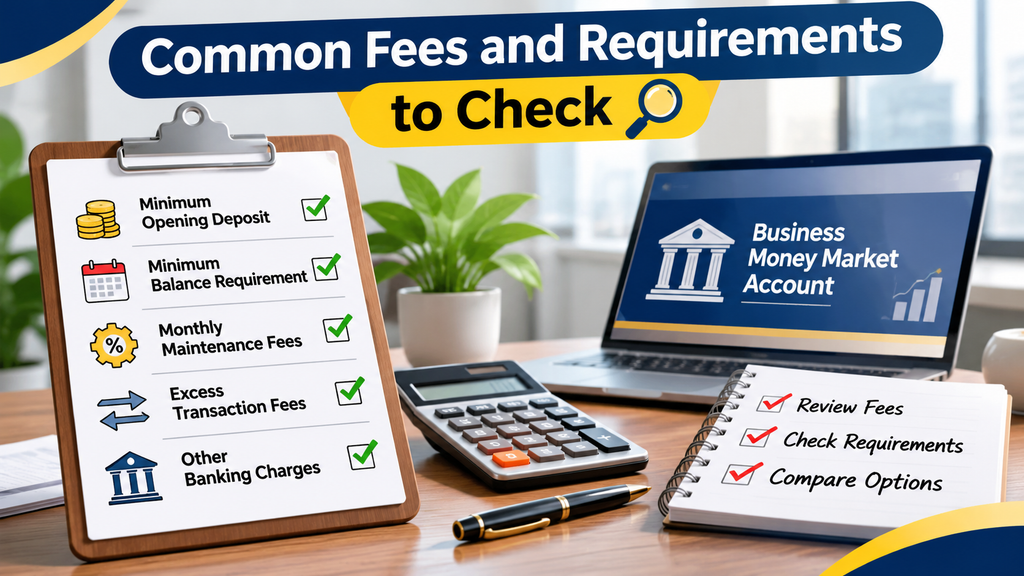
Before opening a business money market account, review its costs. A high interest rate may look attractive, but fees can reduce your actual earnings.
Here are some common requirements to check.
Minimum Opening Deposit
Some banks require a minimum amount when opening an account. This amount can vary based on the bank and account type.
Make sure your business can meet the requirement without affecting its daily cash needs.
Minimum Balance Requirement
Certain accounts require customers to maintain a minimum balance.
If your balance falls below that amount, the bank may charge a monthly maintenance fee or reduce the interest rate.
Monthly Maintenance Fees
Banks may charge a monthly fee for maintaining the account.
Some banks waive this fee when customers maintain a specific balance or meet other conditions.
Excess Transaction Fees
Some accounts limit certain withdrawals or transfers during a statement period.
A bank may charge an additional fee when customers exceed the account’s permitted transaction limit.
Other Banking Charges
Check for possible charges related to wire transfers, returned payments, paper statements, and other banking services.
Reading the fee schedule before opening an account can help prevent unexpected costs.
How to Choose the Best Business Money Market Account
Finding a suitable account requires more than comparing advertised interest rates. Business owners should review the complete account terms.
Here are six points to consider.
1. Compare Annual Percentage Yield (APY)
APY shows how much interest an account may earn over one year, including the effect of compounding.
Compare APYs from several banks rather than looking only at the stated interest rate.
Also check whether the rate is promotional or variable. A promotional rate may change after a limited period.
2. Review Minimum Balance Rules
Check how much money you need to open the account and how much you must keep in it.
Choose an account that fits your average business cash balance.
3. Check Withdrawal Options
Think about how often your company may need to access its savings.
If you need regular transfers, look for an account with suitable online banking options and clear withdrawal rules.
4. Check Bank Security
Choose an FDIC-insured bank or an eligible federally insured credit union.
Confirm the institution’s insurance status and review how the bank handles business deposit coverage.
5. Review Online Banking Features
Good online banking access can make business cash management easier.
Check whether the account supports mobile banking, electronic statements, account alerts, and transfers between business accounts.
6. Read the Full Account Agreement
Do not make a decision based on a short advertisement.
Review the complete terms, including interest calculations, fees, balance requirements, transaction limits, and account restrictions.
Practical Example: How Much Interest Can a Business Earn?
Let’s look at a simple example to see how interest may benefit a company.
Suppose a business deposits $25,000 into an account with a 3% APY.
If the APY stays the same for one year and the money remains in the account, the estimated interest would be around $750.
Here is a simple comparison:
| Starting Balance | Example APY | Estimated Annual Interest |
|---|---|---|
| $5,000 | 3% | $150 |
| $10,000 | 3% | $300 |
| $25,000 | 3% | $750 |
| $50,000 | 3% | $1,500 |
These figures are examples, not current bank offers. Actual earnings depend on the bank’s APY, balance changes, fees, and account terms.
This example shows why comparing interest rates can matter when a business keeps a large amount of extra cash.
Who Should Open a Business Money Market Account?
These accounts may suit different types of businesses.
Small business owners: They can keep extra funds separate from everyday operating money.
Online businesses: E-commerce companies can save money for inventory, advertising, shipping, and future expenses.
Freelancers and consultants: Independent professionals with steady income may use an interest-bearing account to hold funds for taxes and planned costs.
Seasonal businesses: Companies with busy and slow periods can save part of their earnings during stronger months.
Growing companies: Businesses with higher cash balances may benefit from comparing interest rates and account features.
However, a money market account may not suit a business that needs to make frequent payments from its savings. In that case, a regular checking account may be more practical.
Common Mistakes to Avoid
Choosing the wrong account can cost a business money. Avoid these common mistakes.
- Choosing an account based only on APY: A high rate may come with strict balance requirements or extra fees.
- Ignoring withdrawal rules: Some accounts limit certain types of transfers and payments.
- Keeping too much money in one place: Review your FDIC or NCUA insurance coverage before depositing large amounts.
- Using savings for daily expenses: Keep enough money in your checking account for regular business payments.
- Ignoring changing interest rates: Variable rates can rise or fall over time.
- Skipping the account agreement: Read the terms before signing up.
A little research before opening an account can help a business avoid these problems.
Frequently Asked Questions (FAQs)
1. What is a business money market account used for?
A business money market account is used to hold extra company cash while earning interest. Businesses can use it for emergency savings, future purchases, tax reserves, and other planned expenses.
2. Is a business money market account FDIC-insured?
Yes, eligible money market deposit accounts at FDIC-insured banks receive deposit insurance. The standard limit is $250,000 per depositor, per insured bank, for each ownership category. The rules for sole proprietorships differ from those for corporations and partnerships.
3. Can I withdraw money from a business money market account?
Yes. Most accounts allow withdrawals and transfers, but the available methods and transaction limits depend on the bank. Check the account agreement before opening one.
4. Does a business money market account earn interest?
Yes. These accounts generally pay interest on the deposited balance. The rate may be fixed for a limited period or variable, depending on the bank.
5. Is a money market account better than a business savings account?
Neither account is always better. A money market account may offer additional access options, while a regular savings account may have simpler requirements. Compare the APY, fees, and withdrawal rules before choosing.
6. What is the minimum deposit for a business money market account?
The minimum deposit varies by bank. Some financial institutions allow businesses to open an account with a small deposit, while others require a higher amount.
7. Can an LLC open a business money market account?
Yes. Many banks allow eligible limited liability companies to open business money market accounts. The bank may request formation documents, an Employer Identification Number (EIN), identification, and other business records.
8. Can I use a business money market account for payroll?
It depends on the bank’s account features. Some accounts offer payment options, but withdrawal limits may make them unsuitable for regular payroll. A business checking account is generally better for frequent payroll transactions.
9. Can the interest rate change?
Yes. Many business money market accounts have variable interest rates. Banks can change these rates based on market conditions and their account policies.
10. How much money should a business keep in a money market account?
There is no single amount that works for every company. A business should first cover its operating expenses and short-term obligations. It can then consider placing suitable extra cash in an interest-bearing account.
Final Thoughts
A business money market account can be a useful option for companies that want to earn interest on extra cash without locking their money away for a fixed period.
Oakleigh Small Business Accountant and How to Choose the Right One
Youth Entrepreneurship Support Programme: Building Business Opportunities
It can help business owners separate savings from daily operating funds, prepare for future expenses, and earn additional income on eligible deposits.
However, the right account depends on your company’s financial needs. Before making a decision, compare APYs, minimum balance requirements, monthly fees, withdrawal options, and deposit insurance coverage.
Take time to read the full account agreement and calculate how much interest your business may earn after fees.
A good banking choice should support your business savings plan while keeping enough cash available for everyday needs.






5 Comments