

Choosing a website company sounds simple until you start comparing agencies, freelancers, website builders, prices, portfolios, and service packages. Many companies look excellent on a sales page, but the right choice depends on what your business actually needs.
The best website design companies for small business should do more than create an attractive homepage. They should understand your customers, build a site that works on mobile devices, organize your services clearly, and give you a website that you can manage after launch.
A small business usually does not need the same type of website as a large corporation. A local plumber, accounting firm, restaurant, online store, consultant, and marketing agency can all need very different features.
That is why choosing a web design partner should start with your business goals rather than a portfolio screenshot.
Start With What Your Website Needs to Do
Before looking at the best website design companies for small business, write down what you expect the website to achieve.
For some companies, the main goal is getting phone calls. Others need quote requests, bookings, product sales, email signups, or visitors to a physical location.
Your goal affects the type of website you need.
For example, a local service business may need:
- Service pages
- Contact forms
- Click-to-call buttons
- Customer reviews
- Location or service-area pages
- Business hours
- Quote requests
An ecommerce business may need product categories, product pages, shopping cart features, payment processing, shipping information, and customer accounts.
A professional consultant may need case studies, service pages, testimonials, appointment booking, and a strong About page.
The best website design companies for small business should ask questions about these requirements before giving you a final proposal.
Be careful if a company immediately recommends a fixed package without asking about your business, customers, content, goals, or existing website.
A useful first step is to make a simple list of your must-have features and another list of features that would be nice to have. This makes it much easier to compare proposals.
Look Beyond the Portfolio
A beautiful portfolio can help you judge design quality, but it should not be the only reason you choose a company.
Some websites look impressive in screenshots but are difficult to use in real life. Before hiring a company, open several of its previous websites on your phone.
Check how quickly the pages load. Look at the navigation. Try the contact form. See whether buttons are easy to tap. Check whether the text remains readable on a smaller screen.
The best website design companies for small business should be able to explain why a particular layout was used, not simply show you attractive designs.
Ask about the actual work behind the portfolio.
Useful questions include:
- What was the client’s original problem?
- What platform was used?
- How long did the project take?
- Was the content provided by the client or agency?
- What SEO work was included?
- Who manages the website after launch?
- Can the client make basic changes?
- What happens if the business needs new pages later?
You can also use independent directories when comparing providers. For example, Clutch currently lets users compare small-business web design firms using factors such as reviews, experience, pricing, company size, and service focus. Clutch’s small-business web design listings
This type of third-party information is more useful than relying only on testimonials displayed by the company itself.
Compare Price With What You Actually Get
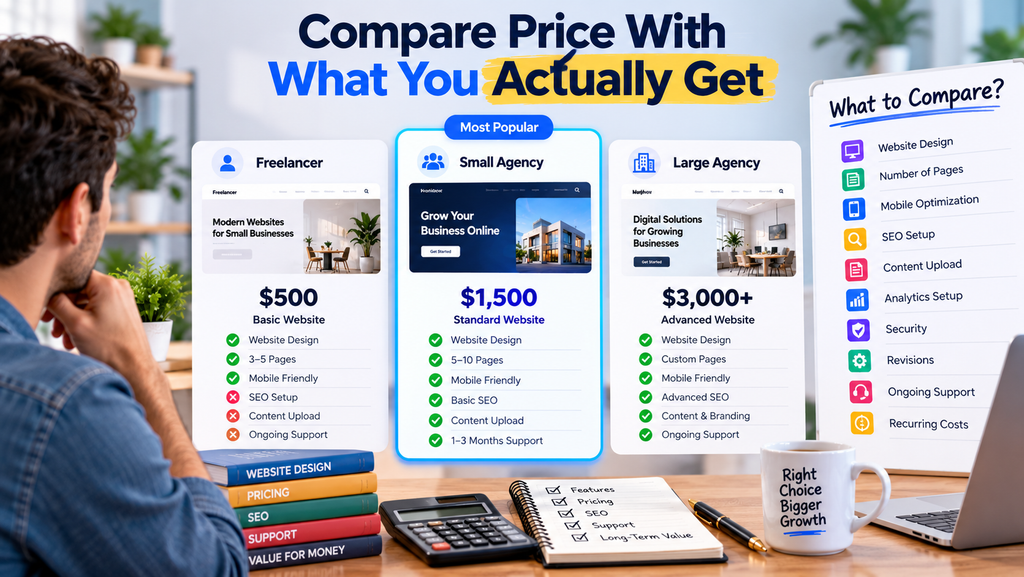
Price is one of the biggest differences between web design providers.
A freelancer may charge much less than an agency. A small studio may offer a middle-ground option, while a large agency may charge much more because it provides strategy, design, development, project management, SEO, content, and ongoing support.
The best website design companies for small business are not automatically the cheapest or most expensive.
Instead of asking only, “How much does a website cost?” ask, “What am I receiving for this price?”
A proposal should make clear whether the price includes:
- Website design
- Website development
- Number of pages
- Mobile optimization
- Content upload
- Contact forms
- Basic SEO
- Analytics setup
- Domain or hosting
- Security
- Revisions
- Training
- Maintenance
- Future updates
Suppose Company A charges $1,000 and Company B charges $2,000. The cheaper option may look better at first, but if Company A excludes content setup, mobile adjustments, SEO basics, and post-launch support, the difference may become smaller than expected.
Also ask about recurring costs.
A website can have expenses after launch for hosting, domain renewal, premium plugins, security services, backups, maintenance, and technical support.
You should know these costs before signing a contract.
Check Their SEO and Technical Skills
A website can look excellent and still perform poorly if its technical setup is weak.
The best website design companies for small business should understand the basic SEO requirements of a modern website.
Ask whether they will set up:
- Search-friendly page titles
- Meta descriptions
- Proper heading structure
- Clean URLs
- Image alt text
- Internal links
- Mobile-friendly layouts
- XML sitemap
- Search Console connection
- Analytics
- Basic page-speed optimization
This does not mean your web designer must provide a complete ongoing SEO campaign. But the website should give future SEO work a good foundation.
Google recommends people-first content, clear site purpose, useful information, and pages that provide real value to visitors. It also recommends using words people would search for in important descriptive areas of a page.
For a small business, this matters because the website often becomes the central place where customers learn about products or services.
You should also ask who owns the website after completion.
Make sure you have access to the domain, hosting account, website platform, content, images, and other important assets. You do not want to discover later that the entire website is controlled by a company you can no longer reach.
If your business is also working on its broader website strategy, you can connect this topic with your existing article on small business website design services.
Pick a Company That Fits Your Business Size
One reason people struggle to identify the best website design companies for small business is that there is no single company that fits every business.
A five-person local company may not need a large agency with a long enterprise-style process.
On the other hand, a small business planning a large ecommerce store may need a development team with stronger technical skills.
Think about the type of support you need.
- Freelancer
A freelancer can be a good option for a smaller project with a limited budget. Communication can be direct, but availability may become an issue if the person handles many clients.
- Small Web Studio
A small studio may provide a balance between personal communication and a wider range of skills. You may get access to designers, developers, and SEO support without working with a large corporate agency.
- Large Agency
An agency can be useful for complicated websites, larger ecommerce projects, branding, custom systems, or businesses that need several services at once. The cost can also be higher.
- Website Builder Specialist
Some providers focus on platforms such as WordPress, Shopify, Wix, or other website builders. This can be useful if you want a website that your own team can manage later.
The best website design companies for small business should fit your budget, project size, technical requirements, and expected level of support.
Do not pay for a large agency simply because its website looks impressive. At the same time, do not choose the cheapest freelancer if your project needs custom development and long-term support.
Ask These Questions Before You Sign
Before selecting one of the best website design companies for small business, ask for clear answers about the entire project.
Start with the timeline. Ask when the first design will be ready, when revisions happen, and what could delay the launch.
Then ask about revisions. Some companies include two or three rounds, while others charge separately for changes outside the original scope.
Ask who provides the written content and images. A website can take longer if the business has not prepared its material.
Find out how communication works. Will you have one project manager? Will you communicate by email, chat, or calls? How often will you receive updates?
You should also ask what happens after launch.
A good provider should be able to explain how updates, security problems, backups, bugs, and future changes will be handled.
Finally, ask what happens if you decide to leave. Make sure you can access your website and transfer it to another provider if necessary.
These questions can save you from problems later.
If you are also researching other website-related options, your article on Business Website Templates can naturally support this topic through internal linking.
Conclusion
Finding the best website design companies for small business is less about choosing the company with the most attractive portfolio and more about finding the right match for your goals.
Start by deciding what the website needs to achieve. Then compare portfolios, mobile performance, pricing, technical skills, SEO knowledge, ownership terms, communication, and post-launch support.
A small business website should be easy for customers to understand and easy for the business owner to manage. It should also leave room for future growth instead of forcing the company into a rigid setup.
Take time to compare several providers before making a decision. A clear project scope and the right questions can help you avoid unnecessary costs and choose a website partner that makes sense for your business.