

Customer Satisfaction Index and How to Measure It in 2026
Introduction
Every business wants happy customers, but “happy” is hard to measure. A smiling customer may never return, and a quiet one may be your most loyal. Without a clear number, you are guessing.
A customer satisfaction index turns customer feelings into one clear score. It combines survey answers into a single number you can track over time and use to make decisions.
Small businesses often think satisfaction indexes are only for large companies with research teams. That is not true. Free survey tools and simple formulas let any business measure satisfaction in a few days. This guide explains what a customer satisfaction index is, how it is calculated, the main ways to measure it, and how to use the score to improve your business.
Table of Contents
What Is a Customer Satisfaction Index?
A customer satisfaction index is a single score that shows how satisfied your customers are with your products, services, or experience. Instead of reading hundreds of comments, you get one number that sums up what they think.
The best-known example is the ACSI. The American Customer Satisfaction Index (ACSI) measures satisfaction across whole industries in the United States, from airlines to banks to online stores, using the same method for every company.
A customer satisfaction index is different from a single survey question. One question gives you one answer about one moment, such as delivery speed. An index combines several questions about quality, value, and service into one weighted score that one bad day cannot distort.
Businesses use a customer satisfaction index to spot problems early, track whether changes work, and compare themselves with competitors. A falling score is a warning, and a rising score is proof that improvements are working.
Types of Customer Satisfaction Metrics
There are four common ways to build a customer satisfaction index. Most small businesses start with one method and add others as they grow.
CSAT (Customer Satisfaction Score) is the simplest method. You ask one question, such as “How satisfied were you with your purchase?” Customers answer on a 1 to 5 scale, and your score is the percentage who chose the top two answers. Qualtrics explains how to calculate CSAT with a simple formula.
NPS (Net Promoter Score) measures loyalty instead of satisfaction. You ask: “How likely are you to recommend us to a friend or colleague?” Customers answer on a 0 to 10 scale. Those who answer 9 or 10 are promoters, 0 to 6 are detractors, and the rest are passives. Your score is promoters minus detractors, from -100 to +100.
CES (Customer Effort Score) measures how easy it was to get something done. You ask: “How easy was it to resolve your issue today?” Customers answer on a scale from very difficult to very easy. A low-effort experience usually means a happy customer who will come back.
ACSI (American Customer Satisfaction Index) is a national benchmark, not a tool you run yourself. It uses a cause-and-effect model linking what customers expect, what they experience, and what they do next. Small businesses cannot run the full ACSI model, but they can compare their own scores with published ACSI averages for their industry.
| Method | What It Measures | Question Style | Best For |
|---|---|---|---|
| CSAT | Satisfaction with one experience | 1 to 5 rating scale | Quick feedback after a purchase or support chat |
| NPS | Loyalty and willingness to recommend | 0 to 10 likelihood scale | Tracking long-term customer loyalty |
| CES | Effort needed to get help | Easy to difficult scale | Support teams and service recovery |
| ACSI | Overall satisfaction benchmark | Multi-question model | Comparing your business with industry averages |
Benefits of a Customer Satisfaction Index
- One number everyone understands. A customer satisfaction index gives your whole team a single score to watch, so staff, managers, and owners can all see whether things are getting better or worse.
- Early warning of problems. A falling score shows trouble before it shows up in sales, so you can fix problems while customers are still with you.
- Proof that changes work. When you improve packaging, speed up replies, or train staff, the score shows whether customers noticed. A score measured every quarter turns guesswork into evidence.
- Better decisions about spending. Scores broken down by product, store, or channel show where to invest — if delivery scores are low and product scores are high, fix delivery first.
- Stronger customer retention. Satisfied customers buy again and recommend you to others, so tracking satisfaction protects repeat business cheaply.
- A benchmark against competitors. Published industry averages show whether your score is strong or weak for your market.
How to Measure a Customer Satisfaction Index Step by Step
- Decide what you want to learn. Pick one goal, such as satisfaction after delivery or after a support call. A clear goal keeps the survey short and the results easy to read.
- Choose your method. Start with CSAT for a single experience or NPS for overall loyalty, and add CES later if support effort is a known problem. Keep it simple so customers actually finish the survey.
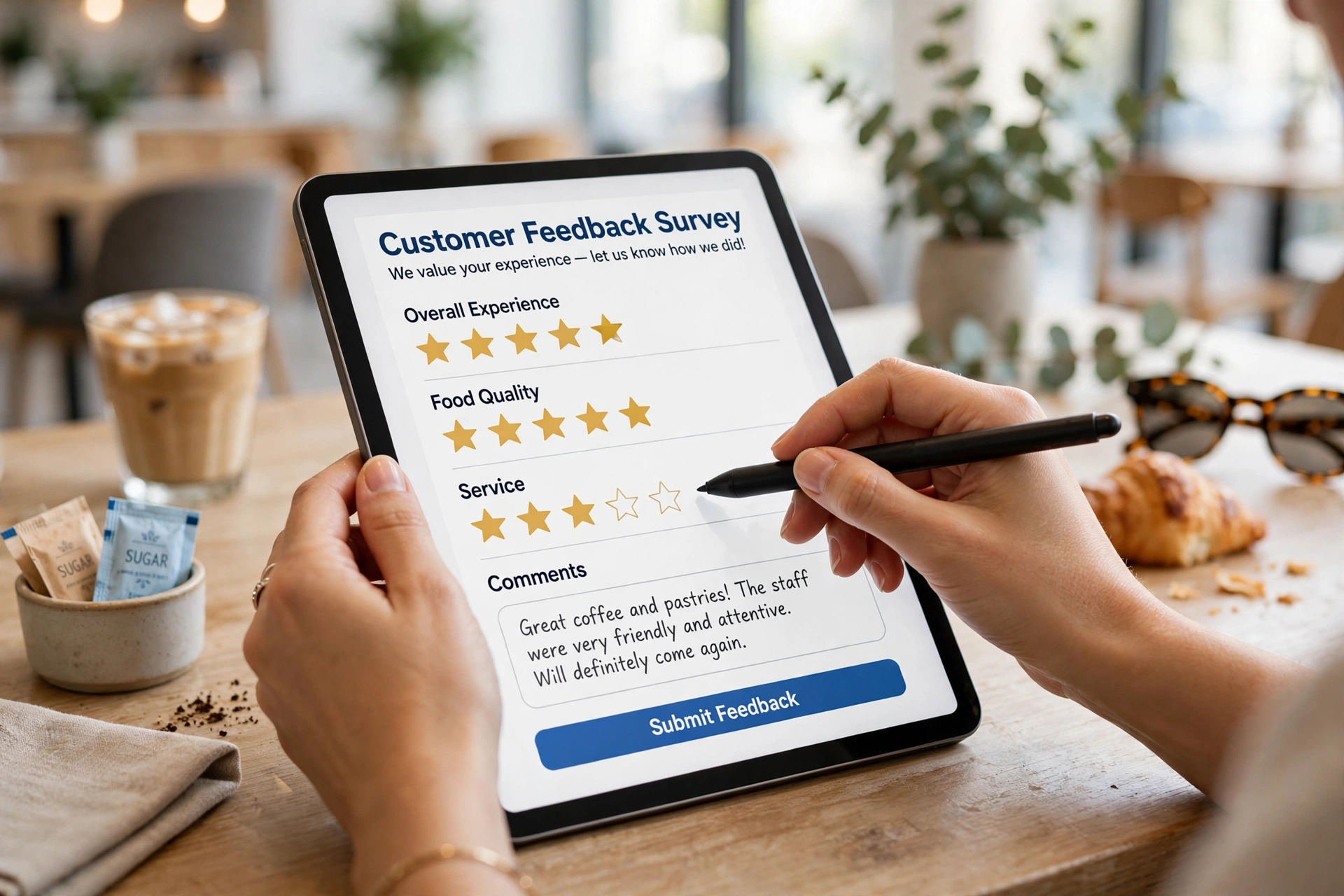
- Write three to five questions. Ask one core question for the score, add a few about quality, value, and service, and end with one open question, such as “What could we do better?” Short surveys get far more answers.
- Pick a survey tool. Free tools such as Google Forms work for a first survey, while dedicated platforms offer templates. SurveyMonkey’s guide to customer satisfaction surveys shows how to write clear questions, choose the right scale, and send the survey at the right moment.
- Send the survey at the right time. Ask right after the experience, while it is fresh in the customer’s mind: within a day of delivery for a purchase, or within an hour of a support call.
- Calculate the score and repeat. Work out your score with the formula for your chosen method, record it, and measure again in three months. The score is only useful when you track it over time, so keep the same questions and the same method for every round.
How to Improve Your Customer Satisfaction Index
Start with the lowest-scoring area, not everything at once. If delivery scores are low, fix delivery. If support scores are low, fix support. Small fixes in the weakest area usually lift the whole score fastest.
Answer every unhappy customer personally. A quick reply, an honest apology, and a fix can turn a detractor into a loyal customer, and saved customers often become your strongest promoters.
Use email to close the loop. After a survey, thank customers and tell them what you changed because of their feedback. Our guide to email marketing shows how to send messages customers actually open.
Speed matters more than most owners think. Customers forgive a mistake far more easily than a slow reply, so set a target response time for support messages and track it every week. AI tools can help too — our guide to AI tools for small business shows how automation answers common questions fast.
Finally, ask happy customers for referrals. Satisfied customers are your best source of new business, and a simple request after a good experience costs nothing. Our lead generation guide explains how to turn them into a steady flow of new leads.
Common Mistakes to Avoid
- Asking too many questions. A twenty-question survey gets ignored. Three to five questions is enough.
- Surveying only happy customers. If you only ask recent buyers, your score will look better than it is. Ask a random sample of all customers, including those who complained.
- Measuring once and stopping. One score tells you where you are today, but nothing about direction. Measure at least every quarter with the same questions.
- Ignoring the open-ended answers. The score tells you how customers feel, but the written comments tell you why. Read them every time and tag the themes that repeat.
- Chasing the score instead of the customer. A high score is not the goal. Happy customers are. Never pressure customers to give high ratings, and never hide bad results from your team.
- Comparing scores across different methods. A CSAT score of 85% and an NPS of 40 are different measures. Compare CSAT with CSAT and NPS with NPS, or the comparison means nothing.
A Practical Example of a Small Online Store
A small online store selling handmade candles has 800 customers a month. The owner suspects delivery is slow, so she sends a short CSAT survey to every customer the day after delivery, asking one rating question and one open question.
After 200 replies, her CSAT score is 74%, below the 80% she hoped for. The open answers show the problem: customers love the candles, but the packaging arrives dented and delivery takes five days.
She switches to sturdier boxes and a faster courier, then repeats the same survey three months later. Her score rises to 86%, repeat orders grow by 15%, and several customers mention the improved packaging. The score did not fix the problem by itself, but it showed her exactly where to spend her money.
Frequently Asked Questions
1. What is a customer satisfaction index?
A customer satisfaction index is a single score that sums up how satisfied customers are with a business. It is built from survey answers about quality, value, and service, combined into one number you can track over time.
2. What is a good score?
There is no single good score, because it depends on the method and the industry. For CSAT, most businesses aim for 80% or higher. For NPS, a score above 0 is good and above 50 is excellent. The most useful comparison is your own score over time and the average for your industry.
3. What is the difference between CSAT, NPS, and CES?
CSAT measures satisfaction with one experience, NPS measures loyalty, and CES measures how easy it was to get something done. They answer different questions, so many businesses use two of them together.
4. How often should I measure customer satisfaction?
Measure at least every quarter, and more often after a big change such as a new product or a price change. Keep the same questions and method each time so scores stay comparable.
5. Do small businesses need to measure satisfaction?
Yes. Small businesses have fewer customers, so losing even a few hurts more. A simple survey with three to five questions costs almost nothing and shows problems while they are still small enough to fix.
6. Can I measure customer satisfaction without a survey tool?
Yes, for a very small business. You can ask customers in person, by phone, or by email, and record answers in a spreadsheet. A survey tool becomes worth it when you have more than a few dozen customers a month.
Final Thoughts
A customer satisfaction index turns vague feelings into a number you can act on. You do not need a research team or an expensive platform. Pick one method, ask three to five short questions, send the survey at the right moment, and measure again in three months.
The score itself is not the prize. The prize is knowing what your customers think, fixing the weakest part first, and watching the number rise. Start small and let your customers tell you where to improve.
Disclaimer: This article is general information, not professional advice. Scores vary by industry and method, so use them as a guide.