
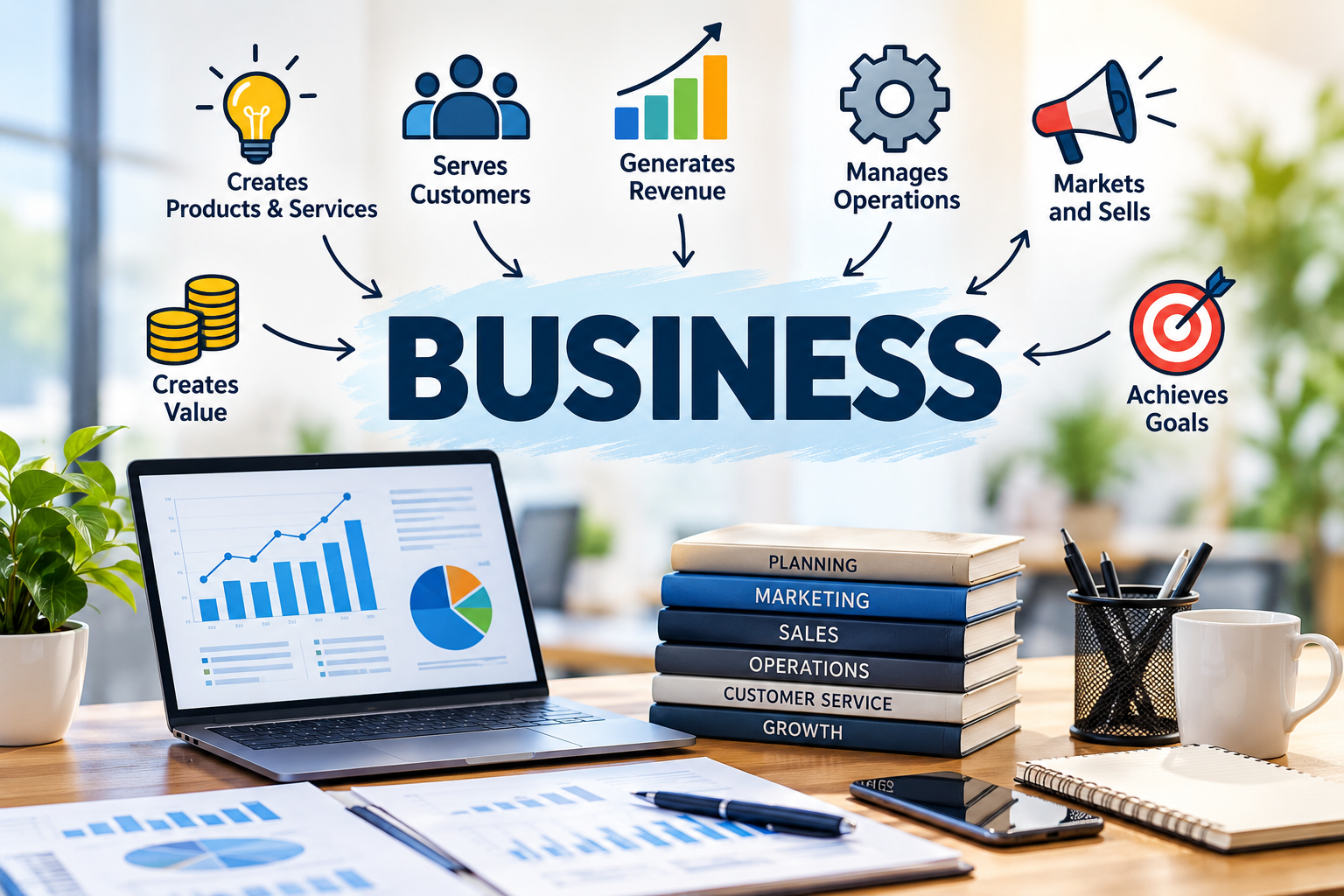
A business provides products or services that solve a problem, meet a need, or give customers something they want. It uses resources such as people, money, materials, equipment, technology, and time to create and deliver value.
The simple answer to the question what does business do is this: a business identifies what customers need, creates or provides a product or service, sells it, and manages the activities needed to keep operating.
A small shop, online store, restaurant, software company, construction firm, and large manufacturer may work in very different ways, but they all perform these basic activities.
What Does a Business Do?
A business usually performs several activities at the same time. These can include:
- Creating products
- Providing services
- Buying materials or products
- Selling to customers
- Marketing and advertising
- Managing employees
- Handling money and expenses
- Delivering products
- Supporting customers
- Planning future growth
For example, a bakery buys flour, sugar, eggs, and other ingredients. Workers use these materials to make bread and cakes. The bakery then markets its products, sells them to customers, collects payments, pays its expenses, and manages its daily operations.
The business takes resources and turns them into something customers are willing to pay for. This basic process is often described as converting inputs into outputs.
Why Do Businesses Exist?
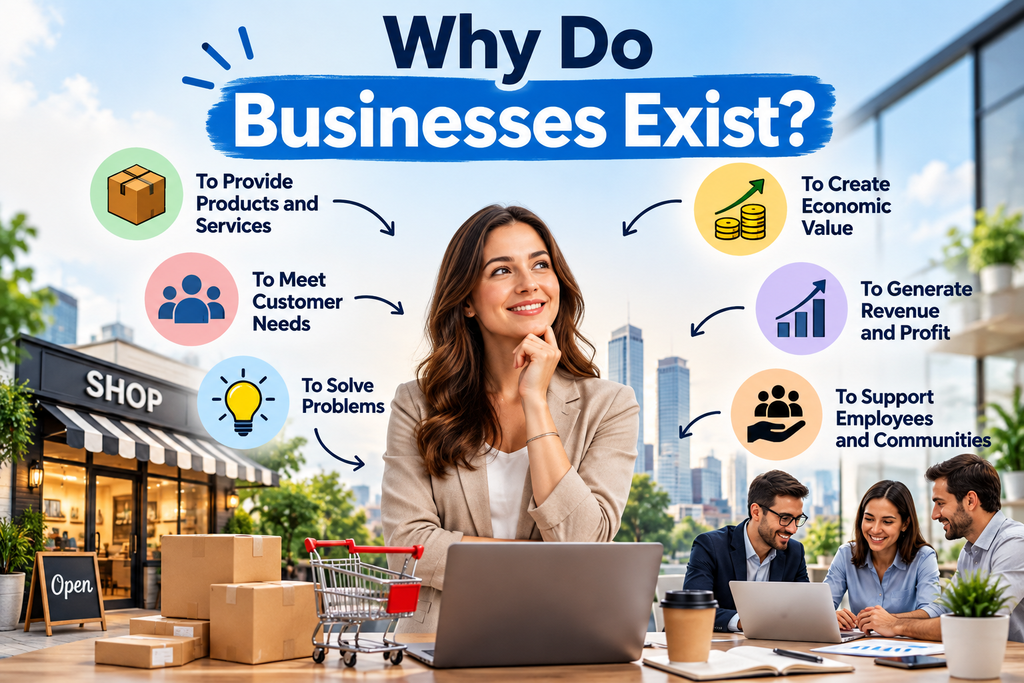
Most commercial businesses exist because customers have needs or wants that can be met through products or services.
Think about a simple example. People need food, but they may not have the time or equipment to prepare every meal themselves. A restaurant provides prepared food and a convenient service. Customers pay the restaurant because they receive something useful in return.
A business can also solve a specific problem.
A plumbing company fixes leaking pipes.
A tutoring company helps students learn.
A software company creates tools for businesses.
A delivery company moves packages from one location to another.
So, a what does business do is more than a way to make money. It creates something useful that people or other organizations are willing to pay for.
How Does a Business Make Money?
A business generally earns money by selling goods or services.
The money received from sales is called revenue. The business then has expenses such as:
- Employee wages
- Rent
- Electricity
- Raw materials
- Equipment
- Advertising
- Software
- Transportation
- Taxes and fees
If the money left after expenses is positive, the business has a profit. If expenses are higher than revenue, the business may have a loss.
For example, suppose a small online store sells $10,000 worth of products in one month. Its total operating expenses are $7,000.
Revenue: $10,000
Expenses: $7,000
Amount left: $3,000
This example shows why sales alone do not tell the full story. A business must also control its expenses and manage its resources carefully.
What Are the Main Activities of a Business?
Different businesses have different daily tasks, but many of them share several basic activities.
1. Producing Goods
Manufacturing businesses make physical products.
For example, a furniture company may buy wood, hardware, paint, and other materials. It uses workers and equipment to turn those materials into tables, chairs, beds, or cabinets.
The finished products are then sold to customers or other businesses.
2. Providing Services
Some businesses do not sell physical products. Instead, they provide services.
Examples include:
- Accountants
- Lawyers
- Doctors
- Designers
- Cleaning companies
- Marketing agencies
- Repair services
- Consulting firms
- Online education companies
In these what does business do, customers pay for skills, time, knowledge, access, or a specific result.
3. Buying and Selling Products
Retail businesses often purchase finished products from manufacturers or wholesalers and sell them to customers.
A grocery store is a simple example. It does not usually manufacture the products on its shelves. Instead, it buys products from suppliers and makes them available to shoppers.
The store creates value by making products easier for customers to find and purchase.
4. Marketing Products and Services
A business also needs customers to know that its products or services exist.
Marketing may include:
- Search engine optimization
- Social media
- Email marketing
- Advertising
- Content marketing
- Promotional offers
- Videos
- Website content
Good marketing explains what the business sells, who it helps, and why customers may need the product or service.
5. Selling to Customers
Sales turn interest into actual purchases.
A sales process can be very simple. A customer sees a product, checks the price, places an order, and pays.
For larger companies, sales may involve meetings, demonstrations, proposals, contracts, negotiations, and follow-up.
6. Managing Customer Service
The work does not always end after a sale.
Customers may need help with:
- Product questions
- Returns
- Repairs
- Payments
- Delivery
- Account problems
- Technical issues
Customer service helps a business maintain good relationships with its buyers.
What Are the Three Main Business Sectors?
Businesses are often grouped into three major sectors based on what they do.
Primary Sector
The primary sector collects or produces raw materials from natural resources.
Examples include:
- Farming
- Fishing
- Mining
- Forestry
- Oil extraction
These businesses provide materials that other businesses may use.
Secondary Sector
The secondary sector turns raw materials into finished or partly finished products.
Examples include:
- Car manufacturing
- Food production
- Clothing factories
- Furniture production
- Construction
For example, a furniture manufacturer may purchase wood and turn it into finished tables and chairs.
Tertiary Sector
The tertiary sector provides services or sells goods directly to customers.
Examples include:
- Restaurants
- Banks
- Retail stores
- Hotels
- Transportation companies
- Hair salons
- Online service providers
Many modern businesses operate in more than one sector or work with companies from several sectors.
What Resources Does a Business Need?
A business needs resources to operate.
People
Employees perform tasks such as production, sales, customer service, accounting, management, and marketing.
Money
Businesses need money to purchase supplies, pay employees, rent locations, advertise products, and cover other costs.
Materials
Manufacturing companies need raw materials. Restaurants need food ingredients. Retail stores need products to sell.
Equipment and Technology
Computers, machines, vehicles, software, websites, and other tools can help what does business do perform their work.
Time
Every business has limited time. Managers must decide which tasks need attention first and how employees should spend their working hours.
How Does a Business Create Value?
A what does business do creates value by making something more useful, convenient, accessible, or desirable for customers.
Consider a simple example.
A farmer grows wheat. A mill turns the wheat into flour. A bakery uses the flour to make bread. A grocery store makes the bread available to local customers.
Each stage changes or moves the product so that it becomes more useful to the next buyer. what does business do can create value through production, distribution, service, convenience, information, or expertise.
What Does a Small Business Do Every Day?
A small business owner may handle many tasks personally.
A typical day could include:
- Checking new orders
- Responding to customers
- Purchasing supplies
- Managing employees
- Creating social media posts
- Checking sales
- Paying bills
- Preparing products
- Delivering orders
- Planning future work
In a larger company, these tasks may be divided among different departments.
For example, the marketing team may promote products, the sales team may find customers, the finance team may manage money, and the operations team may handle production and delivery.
Does Every Business Have the Same Goal?
No. Businesses can have different goals.
A commercial company may focus on earning profit, increasing sales, gaining customers, or expanding into new markets.
Other organizations may focus on providing services to their members or communities rather than distributing profits to owners. The purpose and structure of an organization can therefore vary.
What Is the Difference Between a Business and a Company?
The words business and company are often used in the same way, but they can have different meanings.
Business is a broad term for commercial activity involving the sale of goods or services.
A company is a specific organization or legal entity that carries out business activities.
For example, someone selling handmade products online can operate a small business without having the same structure as a large corporation.
Frequently Asked Questions
What does business do?
A business creates or provides goods and services, sells them to customers, manages its resources, and aims to earn enough revenue to cover its costs and meet its goals.
What is the main purpose of a business?
The purpose depends on the organization. A commercial business generally provides goods or services that customers value while seeking financial returns for its owners.
How does a business earn money?
A what does business do earns money mainly by selling products or services. Its revenue must then cover operating costs and other expenses.
What are examples of business activities?
Business activities include production, purchasing, marketing, sales, customer service, hiring, accounting, delivery, and planning.
What are the three main business sectors?
The three commonly taught sectors are primary, secondary, and tertiary. The primary sector obtains raw materials, the secondary sector processes materials into products, and the tertiary sector provides services or sells goods.
Can one business provide both products and services?
Yes. Many businesses do both. For example, a computer store may sell laptops while also providing installation, repair, and technical support.
Final Thoughts
So, what does business do? A business brings together people, money, materials, knowledge, and other resources to provide products or services that customers value.
Its work can include production, buying, selling, marketing, customer service, financial management, delivery, and planning. The exact activities depend on the type and size of the business.
The easiest way to think about a business is as a system: it uses resources, creates or provides something useful, delivers it to customers, receives revenue, pays its costs, and works to meet its goals.
1 thought on “What Does Business Do? 7 Amazing Ways Businesses Create Value”