

Supply Chain Management Best Guide for 2026
Every product you buy has a long journey behind it. Raw materials are sourced in one place, parts are made in another, and the finished product travels through warehouses and trucks before it reaches your door. Supply chain management keeps that journey running smoothly, on time, and at a reasonable cost.
For a small business, a well-run supply chain can mean the difference between happy customers and lost sales. When products arrive late or run out of stock, customers notice. When everything flows well, you save money and they keep coming back.
In this guide, you will learn what supply chain management is, how it works, the main types and components, the benefits, the mistakes to avoid, and a real example for your business.
Table of Contents
What Is Supply Chain Management?
Supply chain management is the coordination of the people, processes, information, and resources involved in moving a product or service from suppliers to customers. It covers planning, sourcing, making products, managing inventory, filling orders, delivering goods, and handling returns.
In simple words, it is about getting the right product, to the right place, at the right time, at the right cost. It connects purchasing, production, inventory control, transportation, and customer service into one smooth system.
According to Investopedia, effective SCM helps companies reduce costs and waste, avoid shortages and delays, and respond more quickly when demand or supply conditions change. You can read their full explanation at Investopedia. The idea is not new, but it matters more than ever, because customers expect fast delivery while disruptions such as supplier failures and shipping delays can stop a business in its tracks.
How Supply Chain Management Works
SCM works as a connected cycle. The Association for Supply Chain Management organizes the work into seven processes in its SCOR model: orchestrate, plan, order, source, transform, fulfill, and return. Here is how those steps work in practice.
- Orchestrate the whole chain. Set the rules, design the supply network, choose the technology, and decide how performance will be measured.
- Plan demand and supply. Forecast how much customers will buy and what resources you will need to meet that demand.
- Take and process orders. Handle pricing, payment, and order details so every order moves forward without confusion.
- Source materials and products. Buy what you need from suppliers, comparing cost, quality, reliability, and lead time. Use more than one supplier for important items.
- Transform materials into products. Make, assemble, test, and package the product, watching for quality problems, waste, and bottlenecks.
- Fulfill customer orders. Pick, pack, ship, and deliver the products and confirm delivery. Keep backup transport options ready.
- Handle returns. Manage returns, refunds, repairs, recycling, and recalls. Return data can also reveal recurring quality or design problems.
These seven steps repeat in a cycle. Watch the whole cycle and improve the weakest link first.
Key Components of the Supply Chain
A supply chain has several core components, and a weakness in any of them can slow the whole chain down.
Planning and forecasting. Estimate future demand and set inventory targets. Good planning prevents both stockouts and piles of unsold stock.
Sourcing and procurement. Choose suppliers, negotiate prices, and place orders. A reliable supplier who delivers on time is worth more than a cheaper one who misses deadlines.
Manufacturing and production. Turn raw materials into finished products, with production planning, quality checks, and equipment maintenance.
Inventory management. Inventory is money sitting on a shelf. Too much ties up cash and space, and too little means lost sales. Our guide to managing assets explains how to track what your business owns and uses.
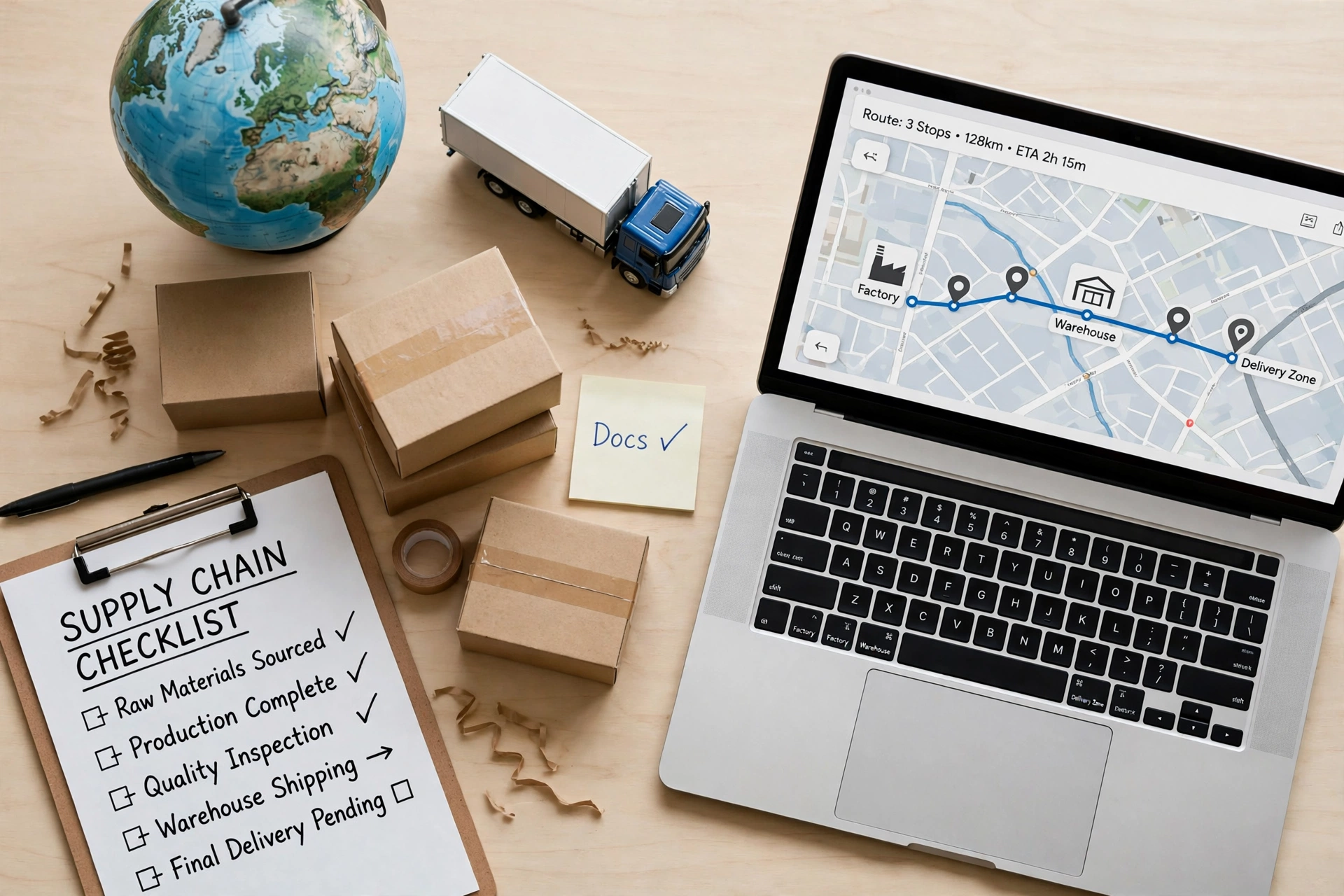
Logistics and warehousing. Warehouses store products between production and delivery, while trucks, ships, and planes move them to customers. Layout, storage, and route planning all affect speed and cost.
Information and technology. Order systems, inventory software, and tracking tools give every partner the same picture, so problems get spotted early.
Types of Supply Chain Management
There is no single model that fits every business. The right type depends on your products, your customers, and how steady your demand is.
Continuous flow model. The business makes the same product again and again and expects steady demand, which works well for mature industries.
Agile model. The business stays flexible and ready to change quickly, which fits unpredictable demand or custom-order products.
Fast model. The business focuses on speed. Products with a short life cycle, such as trendy fashion items, must be made and sold before the trend ends.
Flexible model. The business adjusts production up or down with the seasons, so the chain can grow and shrink as demand changes.
Efficient model. The business competes on cost in an industry with tight margins, tuning every step to use equipment, labor, and inventory efficiently.
Custom model. The business builds its own mix of the models above, common in specialized industries where no standard model fits.
Small businesses often start with a simple efficient or flexible model and adjust as they grow. Choose the model that matches your real demand pattern, not the one that sounds most impressive.
Benefits of Supply Chain Management
When SCM is done well, the benefits show up across the whole business.
- Lower costs. Better planning cuts waste, reduces rush shipping, and keeps inventory at the right level.
- Faster delivery. Smooth processes mean customers get orders sooner, which builds loyalty.
- Fewer stockouts. Forecasting and safety stock keep popular products available, so you stop losing sales.
- Better quality. Checks at each step catch problems early, before a faulty product reaches a customer. Our quality assurance guide explains how to build them in.
- Happier customers. On-time delivery, accurate orders, and easy returns build trust and repeat business.
- Stronger resilience. Backup suppliers and real-time data help your business keep running when a shipment is delayed.
- More room to grow. A chain that works at your current size can scale up as orders grow, instead of becoming a bottleneck.
Best Practices in Supply Chain Management
Good SCM is not about one big fix. It is a set of habits that keep the chain healthy. These best practices work for businesses of any size.
Forecast demand accurately. Use past sales data, seasonal patterns, and market trends to predict demand. Update your forecasts regularly.
Build strong supplier relationships. Treat suppliers as partners: share forecasts, pay on time, and communicate early when plans change.
Keep inventory visible. Use inventory software so you always know what you have and what is running low. Many small businesses lose money because nobody noticed a key item was out of stock.
Plan for disruptions. Keep a backup supplier for critical items and hold safety stock for best sellers. A plan made in calm times beats crisis decisions.
Stay compliant. Supply chains touch rules on safety, labeling, customs, and the environment. A solid compliance management system helps you meet them without slowing down.
Keep learning. The work changes fast as new tools appear. A free course on Coursera is a good way to learn the fundamentals.
Common Mistakes to Avoid
Even good businesses make supply chain mistakes. Here are the ones that cause the most damage.
- Relying on a single supplier. If that supplier fails or raises prices, your whole operation stops, so always have a backup for critical items.
- Guessing demand instead of forecasting it. Ordering on gut feeling leads to overstock of slow items and stockouts of popular ones. Use real sales data.
- Holding too much inventory. Extra stock ties up cash and space and can become outdated. Keep safety stock only where it is truly needed.
- Ignoring the returns process. Returns are part of the chain, not an afterthought. A slow returns process frustrates customers and hides quality problems.
- Chasing the lowest price only. The cheapest supplier is not always the best deal. Late deliveries and poor quality cost more than the savings.
- Never reviewing performance. If you do not measure delivery times, costs, and errors, you cannot improve them. Review them every month.
A Practical Example
Imagine a small business that sells handmade candles online. The owner buys wax, wicks, jars, and oils from four suppliers, makes candles in a small workshop, and ships orders across the country.
At first, she orders supplies only when stock runs low. One supplier takes three weeks to deliver jars, so production stops. During the holidays, orders triple with no plan for the rush, so deliveries go out late.
Then she applies the basics. She forecasts demand from last year’s holiday sales, orders jars six weeks ahead, and keeps two jar suppliers. She tracks inventory in a spreadsheet.
The results show up quickly. Production never stops for missing jars, cash is no longer tied up, and holiday orders ship on time. Nothing about the candles changed. Only the supply chain did, and that was enough to grow sales without adding staff.
Supply Chain Management vs Logistics Management
People often use these two terms as if they mean the same thing, but they are different. Logistics is one part of SCM, as this table shows.
| Feature | Supply Chain Management | Logistics Management |
|---|---|---|
| Scope | The entire chain from suppliers to customers | Moving and storing goods within the chain |
| Main focus | Coordination, planning, and strategy | Transportation, warehousing, and delivery |
| Time frame | Long term planning and relationships | Short term movement of goods |
| Key activities | Sourcing, production, inventory, delivery, returns | Shipping, storage, order picking, and tracking |
| Goal | A smooth, low cost, reliable chain | Fast, accurate, low cost movement of goods |
| Who is involved | Suppliers, makers, distributors, retailers, customers | Carriers, warehouses, and delivery teams |
In short, logistics moves the goods. SCM decides what to move, when, and where, and how the whole system works together. A business needs both, but SCM is the bigger picture.
Frequently Asked Questions
What is supply chain management in simple terms?
It is the planning and coordination of everything involved in getting a product from suppliers to customers: sourcing, making, storing, shipping, and returns.
What is the difference between supply chain management and logistics?
Logistics is one part of SCM. Logistics moves and stores goods. SCM covers the whole chain, from planning and sourcing to delivery and returns.
Why is supply chain management important for small businesses?
It cuts costs, avoids stockouts, speeds up delivery, and keeps customers happy. A small business with a well run supply chain can compete with larger companies.
What are the main types of supply chain management?
The main models are continuous flow, agile, fast, flexible, efficient, and custom. Stable products fit continuous flow or efficient models; unpredictable demand fits agile or flexible ones.
How can I improve supply chain management in my business?
Forecast demand with real sales data, track inventory, and measure on-time delivery and order accuracy. Add a backup supplier for critical items.
What tools do I need for supply chain management?
You can start with spreadsheets and basic inventory software. As you grow, order systems and barcode scanning help.
Final Thoughts
SCM is not only for large companies with huge warehouses. It matters just as much for a small business, where one late shipment or stockout can cost real money and real customers.
Start with the basics: forecast demand, know your suppliers, track inventory, and measure results. Fix the weakest step first. Small improvements add up to lower costs, faster delivery, and happier customers.
The businesses that win in 2026 will treat their supply chain as a strength, not an afterthought. Build yours step by step, and it will pay you back every day.